
The Kidner procedure is a surgical technique for removing an accessory navicular bone and repositioning the posterior tibial tendon to eliminate medial arch pain caused by accessory navicular syndrome. At Certified Foot and Ankle Specialists, our board-certified podiatric surgeons perform this procedure for patients across South and Southwest Florida who haven't found lasting relief through conservative care.
Quick Answers
- What does the Kidner procedure do? It removes the accessory navicular bone and reattaches the posterior tibial tendon to a stronger position on the navicular, restoring the tendon’s ability to support the arch.
- Who needs the Kidner procedure? Patients with Type 2 accessory navicular syndrome who haven’t found relief after 3 to 6 months of orthotics, boot immobilization, and physical therapy.
- How long does the Kidner procedure take? About 45 to 60 minutes, done as outpatient surgery under regional or general anesthesia.
- What is the recovery time after the Kidner procedure? Six weeks non-weight-bearing, then a walking boot and progressive rehab, with most patients back to sports in 3 to 6 months.
- Does insurance cover accessory navicular surgery? Most major plans cover the Kidner procedure (CPT 28238) once conservative treatment has failed and medical necessity is documented.
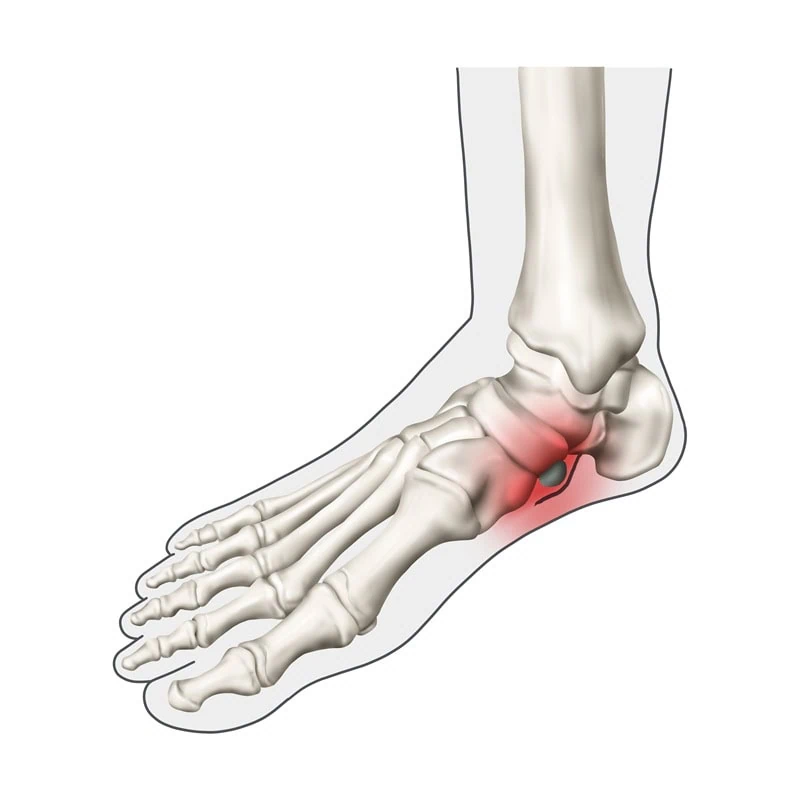
Who Needs the Kidner Procedure?
Not every accessory navicular causes enough trouble to need surgery. The Kidner procedure becomes the right option for a specific group of patients. Candidates typically have a confirmed diagnosis of accessory navicular syndrome, usually a Type 2 bone connected to the navicular by a fibrocartilage bridge. They’ve completed 3 to 6 months of conservative care, orthotics, a CAM boot, and physical therapy, without adequate relief. Pain is limiting daily life, work, or sports, and an MRI shows synchondrosis edema or posterior tibial tendon involvement that explains why conservative measures stopped working. Conservative care comes first for every patient. Surgery is reserved for those who genuinely need it after that approach has had a fair trial, not offered as an early shortcut.
What Happens During the Kidner Procedure?
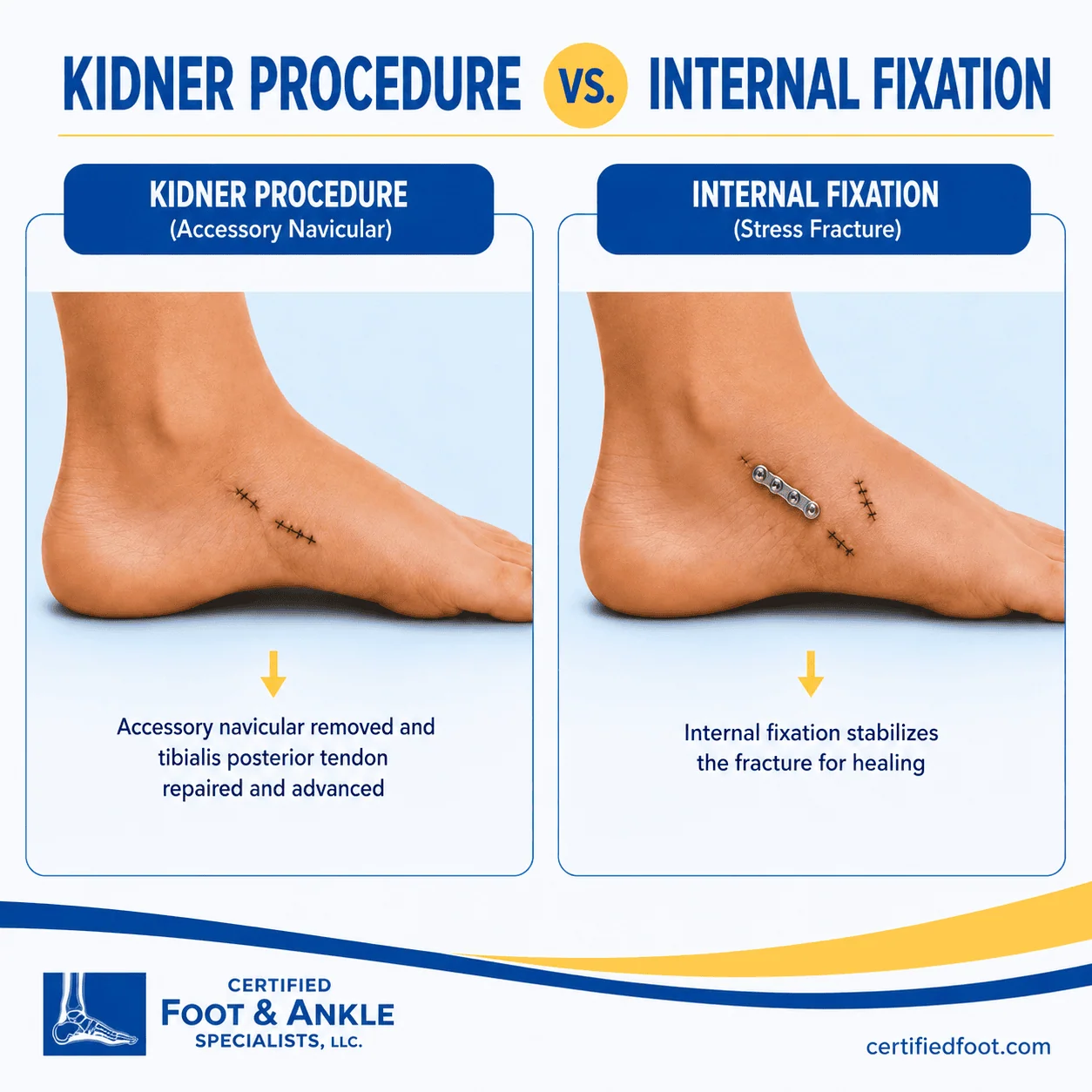
The Kidner procedure is an outpatient surgery that takes about 45 to 60 minutes. Most patients receive a regional block limited to the foot and ankle, though general anesthesia is also an option. The surgeon makes a small incision on the inner side of the foot, directly over the navicular prominence. The accessory bone is excised, and the posterior tibial tendon is reattached to a more plantar insertion point on the navicular. This repositioning is what restores the tendon’s arch-support function, not just removing the bump. Patients with Type 1 or Type 3 accessory naviculars typically need a simpler excision without tendon advancement, which shortens recovery. No plates, screws, or hardware cross the navicular bone in either version. Patients go home the same day in a surgical boot.
What Is the Recovery Timeline After the Kidner Procedure?
- Weeks 1–2: Non-weight-bearing in a surgical cast. Foot elevated. Pain managed with oral medication.
- Weeks 3–6: Non-weight-bearing continues. Sutures removed at 10 to 14 days. Cast switched to fiberglass.
- Weeks 7–10: CAM walker boot replaces the cast. Weight-bearing begins gradually. Physical therapy starts.
- Weeks 10–14: Supportive footwear and custom orthotics take over. Full weight-bearing and strengthening exercises follow.
- Months 3–6: Return to sports and high-impact activity. Final orthotics fitting confirms long-term support.
In a 2022 systematic review published in Current Reviews in Musculoskeletal Medicine, 80 to 90% of patients reported significant pain reduction after accessory navicular surgery, with an average return to sports at 4.5 months and a complication rate under 5% .2 Recovery time is one of the most common questions patients ask before booking, and it’s driven mainly by whether the posterior tibial tendon was advanced or the accessory bone was simply excised.
How Does the Kidner Procedure Compare to Simple Bone Excision?
Not every patient needs the full Kidner procedure. When the accessory navicular is Type 1 or Type 3 and the posterior tibial tendon isn’t compromised, a simpler excision alone can resolve symptoms with a shorter recovery.
Does Insurance Cover the Kidner Procedure?
Most major insurance plans cover the Kidner procedure under CPT code 28238 when it’s medically necessary. Medical necessity means documented conservative care failure over 3 to 6 months, backed by imaging that confirms the condition. Patients often ask about the Kidner procedure CPT code and out-of-pocket cost up front, so it’s worth confirming both with your carrier before scheduling. Prior authorization is typically required, and our team handles that process directly. Before scheduling, call your nearest Certified Foot and Ankle Specialists location to verify your specific benefits. Self-pay options are also available. Call for a personalized Kidner procedure cost estimate.
Factor |
Kidner Procedure (Full) |
Simple Excision Only |
|---|---|---|
| Best for | Type 2 with tendon stress | Type 1 or Type 3 |
| Tendon repositioned | Yes | No |
| Non-weight-bearing | 6 weeks | 4 weeks |
| Return to sports | 3–6 months | 6–10 weeks |
| Arch support improvement | Yes (tendon advancement) | No |
| Hardware | None | None |
Why Choose certified Foot and Ankle Specialists for Accessory Navicular Surgery in Florida?
Certified Foot and Ankle Specialists is a multi-location podiatric surgery practice in South Florida and Southwest Florida, with board-certified foot and ankle surgeons performing the Kidner procedure and other reconstructive foot procedures at locations across Fort Lauderdale, Coral Springs, Boca Raton, Fort Myers, Cape Coral, and 10 additional Florida cities. Dr. Ashley Bowles, DPM, FACFAS, CWSP, treats East Coast and South Florida patients at our Fort Lauderdale, Coral Springs, Boca Raton, Plantation, Delray Beach, West Palm Beach, Boynton Beach, and Palm Harbor locations. Dr. Victor L. Herrera, DPM, ABMSP, treats West Coast patients at Fort Myers and Cape Coral.
Citations
- Kidner FC. The prehallux (accessory scaphoid) in its relation to flat-foot. J Bone Joint Surg Am. 1929;11(4):831–837.
- Wariach S, Karim K, Sarraj M, Gaber K, Singh A, Kishta W. Assessing the Outcomes Associated with Accessory Navicular Bone Surgery-a Systematic Review. Curr Rev Musculoskelet Med. 2022 Oct;15(5):377-384. doi: 10.1007/s12178-022-09772-5. Epub 2022 Jul 1. PMID: 35776339; PMCID: PMC9463416.
- American College of Foot and Ankle Surgeons (ACFAS). Accessory Navicular Syndrome. FootHealthFacts.org.
Frequently Asked Questions About Kidner Procedure
Q: What does the Kidner procedure do?
A: It removes the accessory navicular bone and reattaches the posterior tibial tendon to a stronger position on the navicular. This relieves pressure on the bone and restores the tendon’s ability to support the arch.
Q: Who is a candidate for the Kidner procedure?
A: Patients with Type 2 accessory navicular syndrome who haven’t found relief after 3 to 6 months of orthotics, boot immobilization, and physical therapy are typical candidates. An MRI showing synchondrosis edema or tendon involvement usually confirms the need for surgery.
Q: How long is Kidner procedure recovery?
A: Patients are non-weight-bearing for 6 weeks, then transition to a walking boot and physical therapy. Most return to sports and high-impact activity within 3 to 6 months.
Q: Does insurance cover accessory navicular surgery?
A: Most major insurance plans cover the Kidner procedure under CPT code 28238 when conservative care has failed and medical necessity is documented. CFAS handles prior authorization for patients.
Q: What is the success rate of the Kidner procedure?
A: A 2022 systematic review found that 80 to 90% of patients report significant pain reduction after the Kidner procedure, with a complication rate under 5%.
Appointment for Kidner Procedure Surgery
As usual, the doctors at Certified Foot and Ankle Specialists are here to help you and discuss any concerns you may have. If you have questions about the kidner procedure, make an appointment with one of our Podiatrists.


