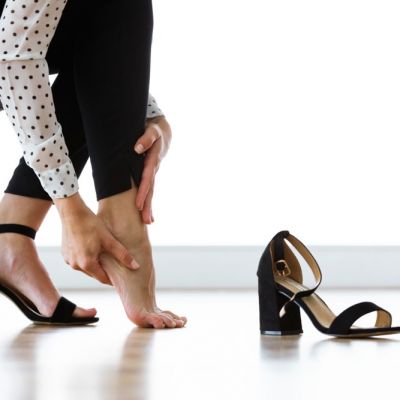
Plantar fasciitis is the most common cause of heel pain we treat at Certified Foot and Ankle Specialists. Our board-certified podiatric surgeons offer every level of care, from conservative management to EPAT, injections, and surgical release at 14 clinic locations across South and Southwest Florida.
Symptoms of Plantar Fasciitis — When to See a Podiatrist
- Sharp, stabbing pain at the base of the heel with your first step in the morning
- Heel pain that eases after a few minutes of walking, then returns with prolonged standing or activity
- Arch pain or tightness along the bottom of the foot
- Pain that is worst after (not during) exercise
- Tenderness when pressing on the inner heel or arch
- Pain that hasn’t improved after two weeks of rest and OTC care
If heel pain is severe enough to change how you walk, or it hasn’t improved after two weeks of basic self-care, come in. Delayed treatment allows calf tightness and gait compensations to entrench — both extend recovery time. Read about out full guide on plantar fasciitis symptoms, causes, and what else heel pain could be.
Plantar Fasciitis Treatment Options at CFAS
Conservative Care First
Nonsurgical treatment resolves plantar fasciitis in approximately 90% of patients within 10 months, and it’s always where we start.1 2
- Calf and plantar fascia stretches address the underlying tightness driving the problem. We walk you through technique at the visit — form matters, and doing it wrong worsens symptoms.
- Arch support corrects how force distributes across the fascia. We fit OTC inserts at the visit or cast for custom orthotics when your foot structure warrants it.
- Anti-inflammatory management. Consistent NSAID dosing (not just when pain spikes) plus topical gel keeps inflammation from resetting between flares.
- Night splints. For severe morning pain, a dorsiflexion splint keeps the fascia gently stretched during sleep, reducing first-step pain significantly.
- Footwear modification. Specific guidance on support requirements and barefoot time, including which sandal types are acceptable during recovery.
EPAT (Shockwave Therapy)
When conservative treatment hasn’t produced sufficient relief after several weeks, EPAT is our preferred next step before injections or surgery. FDA-cleared, non-invasive, done in-office in under 20 minutes, no anesthesia. High-energy acoustic pulses stimulate tissue healing directly at the injury site.
Injection Therapy
When pain prevents you from doing the stretching and activity that drives recovery, targeted injections reduce inflammation quickly. We offer four options based on severity, duration, and tissue condition:
- Corticosteroid (cortisone) injections — fast-acting anti-inflammatory relief. Used alongside conservative care to enable active recovery, not as a standalone treatment. We limit frequency per site because repeated cortisone weakens the fascia over time.
- Platelet-rich plasma (PRP) — concentrated healing growth factors from your own blood, delivered directly to the injury site. Most effective for chronic cases where standard anti-inflammatory approaches have plateaued.
- Stem cell therapy — supports tissue regeneration in patients with significant chronic degeneration or failed prior treatment.
- Amniotic fluid injections — anti-inflammatory and regenerative properties for recalcitrant cases where earlier options haven’t provided lasting relief.
When Does Plantar Fasciitis Require Surgery?
Surgery is a last resort. We consider it only after a minimum of six months of supervised conservative care which includes stretching, orthotics, EPAT, and at least one injection round without adequate relief. Most patients never reach this stage.
The procedure is a plantar fasciotomy: a partial release of the fascia at its calcaneal attachment. Minimally invasive, outpatient, under local anesthesia. Most patients are weight-bearing in a surgical boot within days and return to full activity in 8-12 weeks. Post-surgical physiotherapy is standard.
Surgery may be appropriate when:
- Pain has persisted beyond six months of structured, supervised conservative care
- EPAT and injection therapy have not provided adequate relief
- Imaging confirms significant fascial degeneration rather than acute inflammation
Sources
- Evaluation and Treatment of Chronic Plantar Fasciitis. pmc.ncbi.nlm.nih.gov
- The Diagnosis And Treatment of Heel Pain acfas.org
Plantar Fasciitis Care Across South and Southwest Florida
We treat plantar fasciitis at 14 clinic locations across Florida. East Coast patients can be seen in Boca Raton, Boynton Beach, West Palm Beach, Fort Lauderdale, Pembroke Pines, Coral Springs, Coconut Creek, and Vero Beach. West Coast patients can reach us in Fort Myers, Cape Coral, Tampa, St. Petersburg, Palm Harbor, and Brandon.
We accept most major insurance plans. HealOW online booking is available at all locations — no phone call required.
Frequently Asked Questions
Most patients don’t. Approximately 90% of cases resolve with nonsurgical treatment within 10 months. [Sources: JAAOS 2008; ACFAS 2010] Surgery is reserved for patients who haven’t responded after six or more months of structured conservative and interventional care. At your first visit, we’ll tell you honestly where you are in that continuum.
We offer corticosteroid (cortisone), PRP, stem cell, and amniotic fluid injections. The right option depends on how long you’ve had symptoms, your imaging, and how your tissue has responded to prior treatment. Our podiatrists select based on your clinical picture, not a standard protocol.
Most major insurance plans cover office visits, X-rays, and custom orthotics when medically indicated. Coverage for EPAT and advanced injection therapies varies by plan. Call our billing team before your visit and we’ll confirm your specific benefits.
For acute heel pain, we offer same-week appointments at most locations. Use HealOW online booking or call the clinic nearest you. Walk-in availability varies by location.
Conservative treatment: meaningful improvement within 3-6 months with consistent daily care; most patients substantially better within 10 months. EPAT shortens the timeline for many patients. Surgical recovery: weight-bearing in a boot within days, full return to activity in 8-12 weeks with physiotherapy.
For heel pain that isn’t improving, our board-certified podiatric surgeons across South and Southwest Florida are ready to evaluate and treat it — often in a single visit.