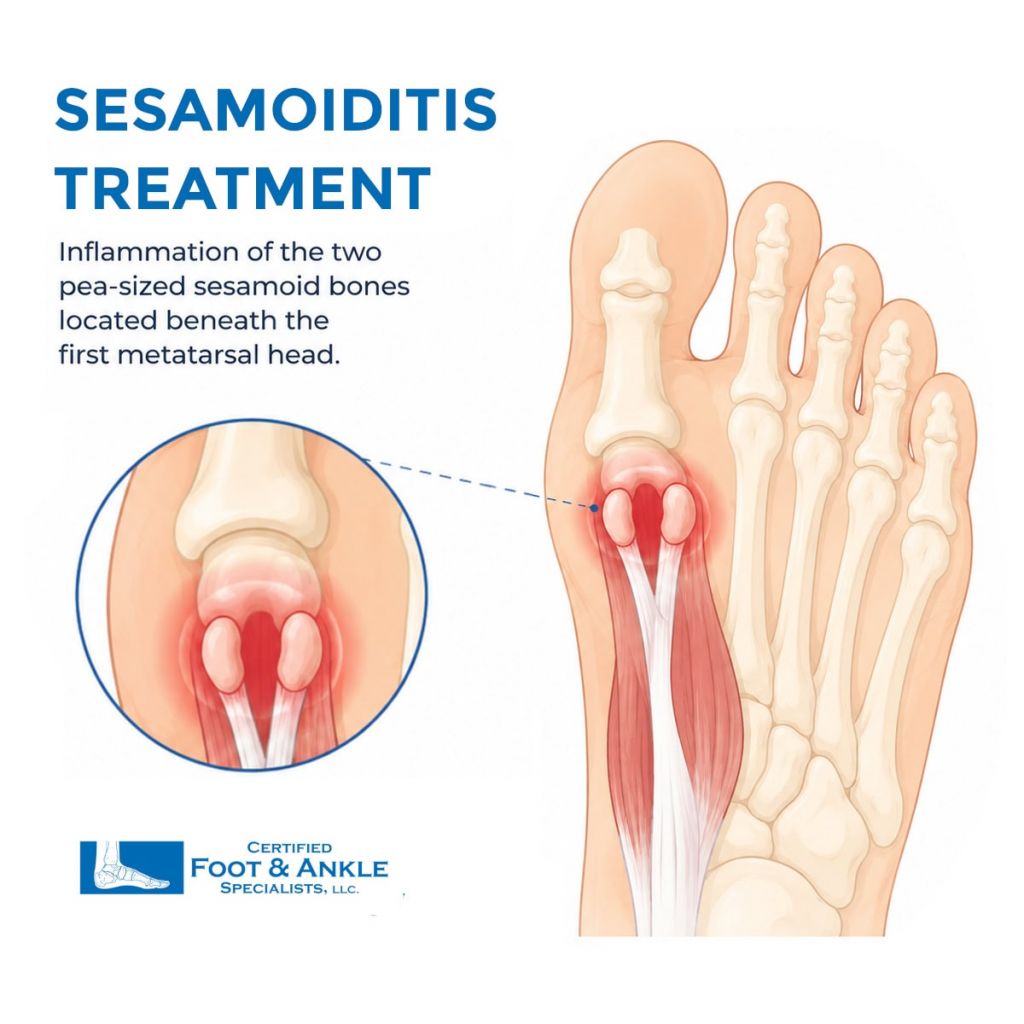
Sesamoiditis treatment targets the inflammation of the two small sesamoid bones embedded beneath the first metatarsal head at the base of the big toe, typically caused by repetitive stress that exceeds what the flexor hallucis longus tendon and surrounding soft tissue can absorb.
Quick Answers: Sesamoiditis Treatment
- What is sesamoiditis? Sesamoiditis is inflammation of the two pea-sized sesamoid bones located beneath the first metatarsal head. It’s the most common forefoot overuse injury in runners, dancers, and anyone who frequently bears weight on the ball of the foot.
- What causes sesamoiditis? Repetitive forefoot loading is the primary driver. Running, jumping, and dancing all concentrate stress on the medial and lateral sesamoids. High arches, tight Achilles tendons, and worn-out footwear accelerate the process.
- How is sesamoiditis treated? First-line treatment is conservative: offloading with orthotics, activity modification, and anti-inflammatory medication. When conservative care doesn’t resolve symptoms within 6-8 weeks, EPAT (shockwave therapy), cortisone injections, or MRI-guided evaluation may be indicated.
- When should I see a podiatrist for sesamoiditis? See a podiatrist if pain under the ball of your foot persists beyond 5-7 days, worsens during or after activity, or limits your ability to walk. Sudden, severe pain after a misstep needs same-day evaluation to rule out a sesamoid fracture.
- How long does sesamoiditis take to heal? Mild sesamoiditis typically resolves in 4-8 weeks with conservative care. Moderate-to-severe cases, or cases involving a bipartite sesamoid or stress fracture, may require 10-16 weeks. Sesamoidectomy surgery is reserved for cases that don’t respond to 3-6 months of non-surgical treatment.
Sesamoiditis and the Sesamoid Bones: What You Should Know
Sesamoiditis is overuse inflammation of the medial and lateral sesamoid bones — two pea-sized bones embedded in the flexor hallucis brevis tendon beneath the first metatarsal head. Because they absorb load with every step, they’re vulnerable to the repetitive stress common in runners, dancers, and active adults.
Sesamoiditis is distinct from a sesamoid bone fracture, though the two can coexist. A bipartite sesamoid is where the medial sesamoid forms in two pieces. This is a normal variant in roughly 10-30% of people and is often misread as a fracture on X-ray. Weight-bearing X-rays and MRI at your CFAS evaluation will confirm the diagnosis and rule out a fracture before treatment begins.
Sesamoiditis Symptoms: Recognizing Forefoot Pain That Warrants Evaluation
The hallmark of sesamoiditis is pain directly under the ball of the foot, at the base of the big toe, that worsens with activity and eases with rest.
Symptoms typically build gradually rather than striking suddenly. Patients often describe:
- A dull ache under the first metatarsal head that intensifies with walking or running
- Sharp pain when pushing off the big toe , especially going up stairs or on hard surfaces
- Tenderness when pressing on the sesamoids from below
- Swelling or bruising in the ball of the foot (present in roughly 30-40% of cases)
- Stiffness in the big toe joint first thing in the morning
Symptoms that signal something more serious such as a fracture, avascular necrosis, or joint infection include sudden severe pain after a specific impact, significant swelling, warmth, or complete inability to bear weight. These warrant same-day evaluation.
If these symptoms sound familiar, a same-visit evaluation at CFAS will confirm the diagnosis and rule out a sesamoid fracture. Call 1-855-550-FEET or book online at any South Florida or Southwest Florida location.
Sesamoiditis Diagnosis at Certified Foot and Ankle Specialists
Sesamoiditis diagnosis requires a clinical exam combined with imaging — either X-ray or MRI — to rule out fracture and assess soft tissue involvement.
At Certified Foot and Ankle Specialists, our evaluation begins with a history of your activity, footwear, and symptom pattern. Your podiatrist palpates both sesamoids individually, tests great toe range of motion, and evaluates your gait.
Standard weight-bearing X-rays rule out an acute sesamoid fracture and identify a bipartite sesamoid. If X-rays are inconclusive, MRI is the preferred next step. It differentiates sesamoiditis from avascular necrosis with far greater accuracy than plain film. For complex cases, CFAS utilizes PedCAT weight-bearing CT scanning, which captures 3D foot anatomy under load.
Sesamoiditis Treatment Options
Conservative care resolves sesamoiditis in approximately 80% of patients when started within the first 4-6 weeks of symptom onset. Treatment matches intensity to severity.
Conservative Treatment (First Line)
- Offloading orthotics and padding – Custom orthotic devices with forefoot modifications reduce pressure on the sesamoids during push-off. A dancer’s pad or sesamoid cut-out achieves immediate pressure relief. Custom orthotics address underlying biomechanical contributors (high arches, excessive forefoot loading) for long-term protection.
- Activity modification – Reducing or temporarily eliminating high-impact forefoot loading (running, jumping, dancing) allows the inflamed tissue to recover. Low-impact cross-training such as swimming and cycling helps maintain one’s fitness without aggravating the sesamoids.
- Anti-inflammatory management – NSAIDs (ibuprofen, naproxen) reduce acute inflammation and pain when used in appropriate doses for short periods under medical supervision. Ice applied for 15 minutes, three times daily, supports this in the first 1-2 weeks.
- Footwear modification – Stiff-soled shoes or a rocker-bottom modification reduce the degree of great toe dorsiflexion during gait, which directly reduces sesamoid stress. Your CFAS podiatrist can recommend specific footwear or refer for a rocker-bottom modification.
- Taping and strapping – Plantarflexion taping of the great toe reduces tension through the flexor hallucis apparatus, offloading the sesamoids during daily activity while more definitive treatment is underway.
Intermediate Treatment (When Conservative Care Stalls)
- Corticosteroid injection – A targeted cortisone injection into the first MTP joint or perisesomoid space reduces acute inflammation when conservative measures plateau. Outcomes are best when combined with orthotics and activity modification, not used as a standalone fix.
- EPAT / Extracorporeal Shockwave Therapy – EPAT delivers acoustic pressure waves that stimulate tissue remodeling and reduce chronic inflammation. It’s a non-surgical, non-injection option for patients who haven’t responded to 6-8 weeks of conservative care. CFAS offers EPAT across South Florida and Southwest Florida locations.
- Short-term immobilization – A removable boot or short leg cast may be prescribed for 4-6 weeks in cases of severe sesamoiditis or confirmed stress fracture to enforce complete offloading.
Sesamoiditis Treatment Comparison: Conservative vs. Surgical
Factor |
Conservative Care |
EPAT / Injection |
Sesamoidectomy (Surgery) |
|---|---|---|---|
| Best for | Mild-moderate, <6 weeks duration | Moderate, failed conservative care | Chronic cases, 3-6+ months failed treatment |
| Recovery | 4-8 weeks | 6-12 weeks | 3-6 months |
| Return to sport | 4-8 weeks, progressive load | 8-14 weeks | 3-6 months with PT protocol |
| Hardware / Injection | None | None (EPAT) / injection only | Small incision, seasonal excised |
| Success rate | ~80%, in early-stage cases 90% | Cortisone 60-70%, EPAT 70% | Good for appropriate candidates, risk of hallux valgus post-medial sesamoidectomy |
| When used at CFAS | All presentations — first-line | After 6-8 weeks of conservative failure | Rare, reserved for recalcitrant or displaced fracture cases |
Most patients start conservative treatment at their first CFAS visit. If you’re in Boca Raton, West Palm Beach, Fort Myers, or surrounding areas, same-week appointments are typically available. Contact us to confirm availability.
When Sesamoiditis Requires Surgery at CFAS
Sesamoid surgery (sesamoidectomy) is rarely needed and is reserved for cases where 3-6 months of documented conservative treatment has failed.
The procedure involves surgical excision of the affected sesamoid through a small incision. Medial sesamoidectomy carries a risk of postoperative hallux valgus if the medial stabilizing structures are disrupted. A consideration that makes surgical planning and technique critical. At CFAS, surgical decisions on sesamoiditis are made after thorough review of imaging, biomechanical profile, and documented conservative care history.
Cases involving avascular necrosis of the sesamoid, where the blood supply has been compromised, typically don’t respond to conservative care and may require earlier surgical consideration. MRI is the diagnostic standard to identify avascular necrosis before it becomes irreversible.
Signs You Should See a Podiatrist for Ball of Foot Pain
See a foot specialist within 5-7 days if forefoot pain doesn’t improve with rest, ice, and over-the-counter anti-inflammatory medication.
Don’t wait if any of these apply:
- Pain is severe enough to alter your gait or limit daily activity
- Swelling is visible or increasing
- Pain began suddenly after a specific impact or awkward step
- Symptoms have been present for more than 2 weeks without improvement
- You have diabetes, peripheral neuropathy, or any condition that impairs wound healing
Schedule Your Sesamoiditis Evaluation at Certified Foot and Ankle Specialists in South Florida
Sesamoiditis responds well to early, targeted care is the key is not letting minor forefoot pain become a chronic condition that limits your activity for months.
Contact Certified Foot and Ankle Specialists to schedule your consultation. Same-visit X-rays and orthotics available at most locations.
Request An Appointment
Frequenty Asked Questions About Sesamoiditis Treatment
Q: Do I need a referral to see a podiatrist for sesamoiditis at CFAS?
A: No referral is required at Certified Foot and Ankle Specialists. You can book directly online or by calling 1-855-550-FEET. Most insurance plans, including Medicare and major commercial carriers, cover podiatric evaluation and conservative sesamoiditis treatment without a primary care referral.
Q: Will I need surgery for sesamoiditis?
A: Most sesamoiditis cases do not require surgery. Approximately 80% resolve with conservative care — custom orthotics, activity modification, and anti-inflammatory treatment — when started within 4-6 weeks. EPAT and cortisone injections are available if conservative treatment stalls. Sesamoidectomy is only considered after 3-6 months of documented non-surgical treatment has failed.
Q: What happens at my first sesamoiditis appointment at CFAS?
A: Your first visit includes a focused physical exam of the big toe and sesamoid area, gait and footwear assessment, and same-visit weight-bearing X-rays to rule out a sesamoid fracture or bipartite sesamoid. If soft tissue involvement is suspected, we may order an MRI or use our in-office PedCAT weight-bearing CT scanner. Most patients leave with a confirmed diagnosis and treatment plan.
Q: How long before I can return to activity after sesamoiditis treatment?
A: Mild sesamoiditis typically resolves in 4-8 weeks with conservative treatment. Moderate cases may require 10-16 weeks. Athletes follow a graduated return-to-activity protocol over 6-12 weeks after symptoms resolve — returning too early increases recurrence risk. Your CFAS podiatrist will set specific return-to-sport milestones based on imaging and clinical progress.
Q: Is sesamoiditis treatment covered by insurance?
A: Conservative sesamoiditis treatment, including evaluation, X-rays, custom orthotics, and cortisone injections, is covered by most major insurance plans and Medicare when medically necessary. EPAT coverage varies by plan. CFAS will verify your benefits before treatment begins and can provide a cost estimate for any out-of-pocket expenses.
Q: Can sesamoiditis come back after treatment?
A: Yes, sesamoiditis has a meaningful recurrence rate if the underlying biomechanical contributors are not addressed. Returning to high-impact activity too early, wearing unsupportive footwear, or ignoring high arch mechanics are the most common triggers. CFAS addresses this with custom orthotics, footwear guidance, and a structured return-to-activity plan designed to protect the sesamoids long-term.
Q: Does CFAS treat sesamoiditis at multiple Florida locations?
A: Yes, CFAS has locations across South Florida and Southwest Florida, including Boca Raton, Delray Beach, West Palm Beach, Boynton Beach, Coral Springs, Fort Myers, and Cape Coral. Dr. Ashley Bowles, DPM, FACFAS, CWSP leads sesamoiditis care on the East Coast, and Dr. Victor L. Herrera, DPM, ABMSP leads care in Fort Myers and Cape Coral.


