Open reduction internal fixation, or ORIF, is surgery to repair a broken bone that can't heal correctly on its own. The surgeon realigns the fracture through an incision (open reduction) and secures it with plates, screws, or rods (internal fixation). At Certified Foot and Ankle Specialists, our board-certified foot and ankle surgeons perform ORIF for displaced and unstable fractures across South and Southwest Florida.
Quick Answers
- What is ORIF? A two-part surgery: open reduction realigns the broken bone through an incision, and internal fixation holds it with plates, screws, or rods while it heals.
- When is ORIF needed? For displaced, unstable, or joint-involving fractures that won’t heal properly in a cast, like bimalleolar ankle, Lisfranc, and displaced fifth metatarsal fractures.
- How long is ORIF surgery? Usually 1 to 2 hours as outpatient or short-stay surgery, depending on the fracture’s complexity.
- How long is recovery after ORIF? Protected weight-bearing for 6 to 12 weeks, then physical therapy, with return to activity in 3 to 6 months.
- Is the hardware removed? Usually no plates, and screws stay in permanently and are only removed if they cause symptoms.
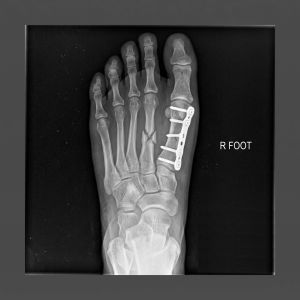
When Is Open Reduction Internal Fixation (ORIF) Needed for a Foot or Ankle Fracture?
Most foot and ankle fractures heal in a cast or boot. ORIF is reserved for fractures where the bone fragments are displaced, unstable, or involve a joint surface, because those won’t heal in the right position without being physically realigned and held there.
A surgeon typically recommends ORIF when the fracture is out of alignment, when a joint surface is involved, when the bone is broken in multiple places, or when an earlier attempt to set the bone without surgery didn’t hold. Which fractures fall into that category:
Fracture Type |
Typically Needs ORIF? |
Why |
|---|---|---|
| Displaced ankle fracture (bimalleolar) | Yes | Joint surface must be realigned precisely |
| Displaced or unstable Lisfranc injury | Yes | Midfoot stability depends on exact alignment |
| Displaced 5th metatarsal (Jones) fracture | Often | Poor blood supply, hardware speeds union |
| Displaced talus or calcaneus fracture | Yes | High-force injuries, joint congruity critical |
| Non-displaced, stable fracture | No | Heals in a cast or boot without surgery |
| Toe fracture | Rarely | Usually buddy-taped or splinted |
Conservative treatment always comes first when the fracture allows it. ORIF is for the fractures that genuinely need it, not a default for every break.
What Happens During ORIF Surgery?
ORIF is often performed as an urgent or emergency procedure, since a displaced fracture needs to be realigned before it starts healing out of position. It’s usually done under regional or general anesthesia as outpatient or short-stay surgery, most often lasting one to two hours depending on the fracture.
The surgeon makes an incision over the fracture to expose the broken bone directly. The fragments are realigned into their correct position, which is the open reduction step. The bone is then secured with internal hardware, typically a metal plate and screws, sometimes rods or wires, chosen to match the fracture pattern and location. This is the internal fixation step. The incision is closed and the foot or ankle is protected in a splint. Because the hardware stays inside the body, there’s no external frame to manage during healing. Most plates and screws are left in permanently and only removed later if they cause irritation. Some patients face a higher risk of complications after Open Reduction Internal Fixation (ORIF). According to Johns Hopkins Medicine, people with low bone density or diabetes, and those who smoke, are more likely to have healing problems. Your surgeon weighs these factors when planning your procedure and recovery.
How Does ORIF Compare to Closed Reduction?
Not every fracture needs an incision. When the bone is stable and can be aligned from the outside, a closed reduction with casting avoids surgery entirely. ORIF is the answer when precise, held alignment matters more than avoiding an incision.
How Does ORIF Compare to Closed Reduction?
Not every fracture needs an incision. When the bone is stable and can be aligned from the outside, a closed reduction with casting avoids surgery entirely. ORIF is the answer when precise, held alignment matters more than avoiding an incision.
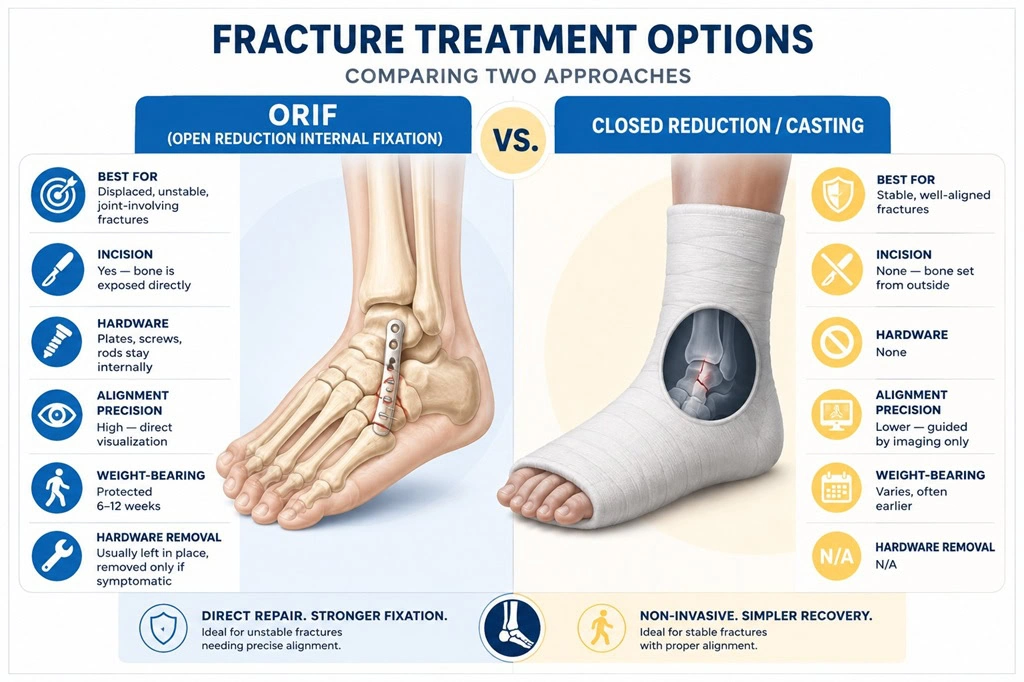
Factor |
ORIF (Open Reduction Internal Fixation) |
Closed Reduction / Casting |
|---|---|---|
| Best for | Displaced, unstable, joint-involving fractures | Stable, well-aligned fractures |
| Incision | Yes — bone is exposed directly | None — bone set from outside |
| Hardware | Plates, screws, rods stay internally | None |
| Alignment precision | High — direct visualization | Lower — guided by imaging only |
| Weight-bearing | Protected 6–12 weeks | Varies, often earlier |
| Hardware removal | Usually left in place, removed only if symptomatic | N/A |
Your surgeon decides between the two based on the fracture’s location, how far it’s displaced, whether a joint is involved, and how stable it is once aligned.
What Is Recovery Like After Open Reduction Internal fixation (ORIF) Surgery?
- Weeks 1–2: Splinted and elevated. Non-weight-bearing. Pain managed with oral medication. Sutures checked at the first follow-up.
- Weeks 2–6: Transition to a cast or boot. Weight-bearing status depends on how stable the fixation is. Imaging confirms the hardware and alignment are holding.
- Weeks 6–12: Protected weight-bearing progresses as healing allows. Physical therapy starts to restore motion and strength.
- Months 3–6: Return to normal daily activity and, eventually, higher-impact activity once the bone is solidly healed and strength returns.
- Up to 12 months: Complete bone remodeling can continue for up to a year. Some patients may not regain full range of motion depending on the injury.
How soon you can put weight on the foot has changed in recent years. Traditional protocols kept patients non-weight-bearing for about six weeks, but current evidence increasingly supports earlier weight-bearing when the fixation is stable. A 2020 study in Foot & Ankle International found comparable healing between patients who began weight-bearing at two weeks versus six weeks after ankle fracture ORIF. Your surgeon decides your specific protocol based on how stable your fixation is, so timelines are individual.
Recovery time is the question patients ask most, and it depends heavily on which bone was broken, how displaced it was, and whether a joint was involved. Ankle ORIF recovery differs from a fifth metatarsal or Lisfranc repair, so timelines are individual.
Does Insurance Cover ORIF Surgery?
Most major insurance plans cover ORIF when it’s medically necessary to repair a displaced or unstable fracture. Coverage depends on your specific plan, the diagnosis, and the documentation supporting surgery. The ankle ORIF CPT codes fall in the 27766–27829 range depending on which bones are fixed, and your carrier uses those codes to determine your benefit. Prior authorization is often required, and our team handles that process. Because fractures are frequently urgent, CFAS works to verify benefits and coordinate care quickly. Call your nearest location to confirm coverage or ask about self-pay options.
Why Choose CFAS for ORIF Surgery in Florida?
Certified Foot and Ankle Specialists is a multi-location podiatric surgery practice across South Florida and Southwest Florida, with board-certified foot and ankle surgeons who repair fractures at locations spanning Fort Lauderdale, Coral Springs, Boca Raton, West Palm Beach, Fort Myers, Cape Coral, and more. Our surgeons focus specifically on the foot and ankle, so fracture fixation in these bones is core to what they do, not an occasional add-on. Our locations coordinate imaging, surgery, and physical therapy, and our in-house orthotic lab supports the transition back to normal footwear once the fracture has healed. For patients across our Florida network, that means fracture care from evaluation through full recovery in one practice.
Citations
- Johns Hopkins Medicine. Ankle Fracture: Open Reduction and Internal Fixation. hopkinsmedicine.org — used for higher-risk-patient factors (diabetes, smoking, low bone density) and the urgent/emergency framing.
- Schubert J, et al. Effect on Overall Health Status with Weightbearing at 2 Weeks vs 6 Weeks After Open Reduction and Internal Fixation of Ankle Fractures. Foot Ankle Int. 2020 Jun;41(6):658–665 — used for the early-vs-delayed weight-bearing point.
- American College of Foot and Ankle Surgeons (ACFAS). Ankle Fractures. FootHealthFacts.org.
- American Academy of Orthopaedic Surgeons (AAOS). Internal Fixation for Fractures. OrthoInfo.
Frequently Asked Questions About internal fixation (ORIF)
Q: What is open reduction and internal fixation (ORIF)?
A: ORIF is a two-part surgery for broken bones. Open reduction means the surgeon makes an incision to realign the bone fragments directly. Internal fixation means the bones are held in place with hardware such as plates, screws, or rods while they heal.
Q: When is ORIF needed for a foot or ankle fracture?
A: ORIF is used for displaced, unstable, or joint-involving fractures that won’t heal correctly in a cast, such as bimalleolar ankle fractures, Lisfranc injuries, and displaced fifth metatarsal fractures. Stable, well-aligned fractures usually heal without surgery.Q:
Q: How long is recovery after ORIF ankle surgery?
A: Most patients progress through protected weight-bearing over the first 6 to 12 weeks, then physical therapy, with return to normal activity in 3 to 6 months. How soon weight-bearing begins depends on how stable the fixation is; current evidence increasingly supports earlier weight-bearing for stable fixations. Complete bone healing can take up to a year.
Q: Is the hardware removed after ORIF?
A: Usually not. Plates and screws are designed to stay in permanently. They’re only removed later if they cause irritation, pain, or other symptoms.
Q: Does insurance cover ORIF surgery?
A: Most major insurance plans cover ORIF when it’s medically necessary to repair a displaced or unstable fracture. Coverage depends on your plan, diagnosis, and documentation. CFAS verifies benefits and handles prior authorization before surgery.
Open Reduction Internal Fixation (ORIF)
If you've broken a bone in your foot or ankle and been told you may need surgery, the board-certified foot and ankle surgeons at Certified Foot and Ankle Specialists can evaluate whether ORIF is right for you. We treat fractures across Fort Lauderdale, Coral Springs, Boca Raton, West Palm Beach, Fort Myers, Cape Coral, and more. Contact your nearest CFAS location to schedule a fracture evaluation.