

Sarah Hubbard
*About the Author: Sarah Hubbard
Sarah Hubbard is a medical writer for Certified Foot and Ankle Specialists with approximately 15 years of experience creating accurate, patient-focused healthcare content. She specializes in translating complex podiatric topics into clear, informative articles that help patients better understand foot and ankle conditions, treatment options, and preventive care.
The Ilizarov external fixator is a circular ring fixation device used by foot and ankle surgeons to stabilize complex fractures, correct bone deformities, and support healing across the tibia, fibula, and ankle joint.
When a fracture or foot deformity is too complex for a standard cast or internal plates, the Ilizarov fixator provides a stable, adjustable solution that works with the body’s natural healing process. It’s used for conditions ranging from severe ankle fractures to Charcot foot reconstruction and fracture nonunion. The device is also called the Ilizarov apparatus or ring fixator in clinical literature.
Certified Foot and Ankle Specialists is a multi-location podiatric surgery practice serving South Florida and Southwest Florid. We are staffed with board-certified foot and ankle surgeons performing complex reconstructive procedures, including Ilizarov circular external fixation, at locations in Boca Raton, Fort Myers, Cape Coral, West Palm Beach, and across the state.
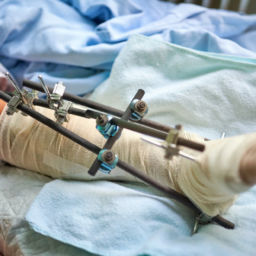
Demonstration of Ilizarov circular external fixation performed by the surgical team at Certified Foot and Ankle Specialists for complex foot and ankle conditions including ankle fractures and deformity correction.
Quick Answers: Ilizarov External Fixator
What is the Ilizarov external fixator? The Ilizarov external fixator is a circular ring fixation system that stabilizes bone segments from outside the body using wires, half-pins, and threaded rods. It’s used for complex ankle fractures, foot deformities, and bone reconstruction when internal hardware isn’t sufficient.
What conditions does it treat? The Ilizarov fixator treats complex ankle and foot fractures, Charcot foot deformity, fracture nonunion, limb length discrepancy, and bone defects caused by infection or trauma.
How is it applied? A foot and ankle surgeon passes thin wires or half-pins through the bone, attaches them to external rings, and connects the rings with threaded rods. The frame sits outside the leg, holding bone fragments in precise alignment without a large incision.
How long do you wear an Ilizarov external fixator? Most patients wear the fixator for 6 to 12 weeks for fracture stabilization, or up to 6 months for complex deformity correction or bone transport.
When should you see a specialist? See a foot and ankle surgeon if you have a fracture that isn’t healing, a foot or ankle deformity causing pain or instability, or a diagnosis of Charcot foot that has progressed to structural collapse.
How does the Ilizarov external fixator work?
The Ilizarov fixator stabilizes bone by holding fragments under controlled tension or compression through an external frame connected directly to the skeleton.
The device was developed by Russian orthopedic surgeon Gavriil Ilizarov in the 1950s. His research showed that bone and soft tissues regenerate predictably when placed under controlled mechanical stress — a principle called distraction osteogenesis. This discovery transformed the treatment of complex fractures, limb deformities, and bone defects worldwide.
The frame consists of three main components:
- Wires and half-pins — Thin Kirschner wires (1.5-1.8mm) or half-pins pass through the skin and bone percutaneously, anchoring the frame to the skeleton without a large incision.
- Circular rings — The rings encircle the limb and connect to the wires under tension, distributing forces evenly around bone segments rather than concentrating stress at a single point.
- Threaded rods — Adjustable rods connect the rings, allowing surgeons or patients to make precise millimeter-level adjustments to alignment, compression, or distraction after the procedure.
This adjustability sets the Ilizarov fixator apart from internal fixation systems. A plate or screw is locked into position at surgery. The Ilizarov frame can be fine-tuned daily for weeks afterward.
What conditions does the Ilizarov fixator treat in the foot and ankle?
Foot and ankle surgeons use the Ilizarov fixator for conditions where standard internal fixation isn’t appropriate or has already failed.
What ankle fractures benefit from the Ilizarov fixator?
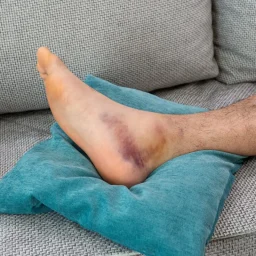
Fractures of the distal tibia, fibula, or talus with significant soft tissue damage, contamination, or bone loss are strong candidates for the Ilizarov system. Swollen or compromised skin around the ankle makes open surgery with plates high-risk. Percutaneous fixation avoids that risk while maintaining precise bone alignment.
How does the Ilizarov fixator treat Charcot foot?
Charcot neuroarthropathy causes progressive joint destruction in patients with peripheral neuropathy, most commonly from diabetes. When Charcot foot reaches structural collapse, circular external fixation stabilizes the foot and ankle during reconstruction. According to the American College of Foot and Ankle Surgeons (ACFAS), external fixation is a primary surgical option for Charcot ankle deformity correction and fusion, particularly in patients where internal hardware infection risk is high.
Can the Ilizarov fixator heal a fracture that won’t mend?
When a bone fails to heal after initial fracture treatment, the Ilizarov frame applies controlled compression across the nonunion site, stimulating new bone formation. The frame can be adjusted over time to maintain optimal conditions for healing.
What about bone loss or infection in the fracture site?
After bone infection (osteomyelitis) or tumor removal, the Ilizarov technique allows bone transport, gradually moving healthy bone across a defect to fill the gap. This avoids bone grafting in many cases and keeps metal hardware out of infected tissue.
Can the Ilizarov fixator correct foot and ankle deformities?
The gradual distraction capability of the Ilizarov system corrects limb length differences and angular deformities in the foot and ankle at approximately 1 millimeter per day. This pace promotes natural soft tissue accommodation and reduces complications compared to acute correction.
How is the Ilizarov external fixator applied during surgery?
Ilizarov fixator application is a surgical procedure performed under general or regional anesthesia, typically taking 1 to 3 hours depending on complexity.
- Pre-surgical planning — The surgeon uses CT imaging and digital planning tools to map the exact ring configuration, wire placement, and correction parameters for the specific fracture or deformity.
- Wire and pin placement — Thin Kirschner wires (1.5-1.8mm diameter) or half-pins pass percutaneously through the bone, anchoring the frame without large incisions.
- Ring assembly — Circular rings are positioned around the limb and connected to the wires under tension. Ring size is matched to the limb diameter, leaving 2-3 cm clearance between skin and frame.
- Rod connection — Threaded rods connect the rings in the appropriate configuration. For compression, rings move toward each other. For distraction, they move apart over subsequent days.
- Post-surgical adjustment — For gradual correction cases, patients or caregivers are taught to adjust the frame at home — typically one-quarter turn (0.25mm) per rod, four times daily, for 1mm of movement per day.
How does the Ilizarov fixator compare to ORIF for ankle fractures?
The Ilizarov fixator and ORIF (open reduction internal fixation) both treat ankle fractures, but they serve different patient situations and fracture types.
ORIF uses plates and screws placed directly onto bone through a surgical incision. It’s the standard approach for uncomplicated ankle fractures with intact, healthy soft tissue. The Ilizarov fixator is chosen when ORIF carries higher risk — typically from soft tissue compromise, infection, bone loss, or complex deformity.
Factor |
Ilizarov External Fixator |
ORIF (Plates & Screws) |
|---|---|---|
| Best for | Complex fractures, Charcot foot, infection risk, bone loss | Stable fractures with intact, healthy soft tissue |
| Incision required | Minimal — percutaneous pin sites only | Yes, open surgical incision |
| Hardware location | External to the skin | Internal (plates, screws, implants) |
| Weight-bearing | Often permitted within 2–4 weeks | Typically 6–8 weeks non-weight-bearing |
| Adjustability post-surgery | Fully adjustable after procedure | Fixed at time of surgery |
| Hardware removal | Frame removed in-office — no second surgery | Second surgery often required |
| Typical device duration | 6–12 weeks (up to 6 months for deformity) | Hardware often permanent |
| When used at CFAS | Complex/infected fractures, Charcot reconstruction, deformity correction | Straightforward ankle fractures with healthy soft tissue |
A 2022 study published in Foot & Ankle International found that Ilizarov circular external fixation achieves comparable or superior outcomes to ORIF in high-risk ankle fractures with soft tissue compromise, with lower rates of wound complications.
The choice between these approaches depends on fracture pattern, soft tissue condition, bone quality, and patient factors including diabetes and circulatory health. Our board-certified podiatric surgeons evaluate each case individually before recommending a fixation strategy.
What should you expect during Ilizarov external fixator recovery?
Most patients wear the Ilizarov fixator for 6 to 12 weeks, though deformity correction or bone transport cases may require the frame for up to 6 months.
What happens while you’re wearing the fixator?
Weight-bearing is often permitted earlier with the Ilizarov frame than with internal fixation. The circular ring design distributes load evenly across bone segments, supporting controlled stress that promotes bone formation. Your surgeon determines weight-bearing status based on fracture type and healing progress.
Pin site care is the most important daily task. Each wire or pin entry point requires cleaning once or twice daily with saline or chlorhexidine to prevent pin tract infection, which is the most common complication. Most pin site infections resolve with oral antibiotics when caught early.
Physical therapy typically begins within the first 2-3 weeks. Range-of-motion exercises for the knee and toes maintain joint mobility while the ankle heals. Strengthening work begins after frame removal.
How is the Ilizarov frame removed?
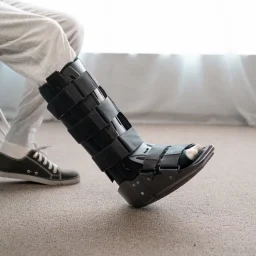
Frame removal is performed in the office or as a brief outpatient procedure under local or light sedation. Unlike internal fixation hardware, no second surgical incision is required. After removal, protected weight-bearing in a boot typically follows for 2-4 weeks as the bone consolidates.
How long until you’re fully recovered?
Return to normal activities typically occurs 3 to 6 months after frame removal, depending on the original condition. Charcot reconstruction and bone transport cases have longer timelines, often 12 to 18 months for full rehabilitation.
When should you see a foot and ankle specialist about external fixation?
See a board-certified podiatric surgeon if you’ve been told your ankle fracture is complex, a previous fracture isn’t healing, or a foot deformity is worsening despite conservative care.
Specific situations that may require external fixation evaluation:
- Ankle fracture with significant swelling or skin compromise — Surgery shouldn’t proceed until soft tissue conditions allow. Your surgeon may recommend temporary external fixation to stabilize the fracture while swelling resolves before definitive treatment.
- Charcot foot that has progressed to structural deformity — Charcot neuroarthropathy (Charcot Foot) in the ankle requires timely surgical intervention to prevent further collapse. External fixation is often central to the reconstruction strategy.
- Fracture that hasn’t healed after 3-4 months — Nonunion rarely resolves without treatment. External fixation combined with biologic stimulation can restart the healing process.
- History of infection in the fracture site — Internal hardware carries infection risk in previously infected bone. The Ilizarov frame keeps metal out of contaminated areas.
- Diabetic patients with complex foot or ankle fractures — Diabetes impairs healing and increases complications from open surgery. Percutaneous fixation with external frames reduces wound risk significantly.
Dr. Ashley Bowles, DPM, FACFAS, CWSP evaluates and treats complex ankle conditions across our South Florida and East Coast locations. Dr. Victor L. Herrera, DPM provides expert foot and ankle surgical care in Fort Myers and Cape Coral. Both physicians work closely with patients through the full evaluation and treatment process for complex fixation cases.
Ready to discuss your treatment options?
The Ilizarov external fixator is a proven surgical solution for complex foot and ankle conditions that can’t be safely managed with standard internal fixation. If you’ve been told you need external fixation or if your ankle fracture, Charcot foot, or bone deformity isn’t responding to current treatment our surgical team can evaluate your options.
Certified Foot and Ankle Specialists provides comprehensive foot and ankle surgery at locations across South Florida and Southwest Florida, including Boca Raton, West Palm Beach, Fort Myers, and Cape Coral. Contact us at 1-855-550-3338 to schedule a consultation with a board-certified podiatric surgeon.
Frequently Asked Questions: Ilizarov External Fixator
Q: What is the Ilizarov external fixator?
A: The Ilizarov external fixator is a circular ring fixation device used by foot and ankle surgeons to stabilize complex fractures, correct bone deformities, and support healing. It consists of external rings connected to the bone through percutaneous wires and half-pins, held together by threaded rods. Unlike internal plates and screws, the frame sits outside the body and can be adjusted after surgery.
Q: What conditions does the Ilizarov fixator treat in the foot and ankle?
A: The Ilizarov fixator treats complex ankle fractures with soft tissue damage, Charcot foot deformity, fracture nonunion, bone defects from infection or tumor removal, and limb length discrepancy. It is particularly useful for diabetic patients and cases where internal hardware carries a high infection or wound complication risk.
Q: How long do you wear an Ilizarov external fixator?
A: Most patients wear the Ilizarov external fixator for 6 to 12 weeks for fracture stabilization. Complex cases involving deformity correction or bone transport may require the frame for up to 6 months. Frame removal is performed in the office without a second surgical incision.
Q: Can you walk with an Ilizarov external fixator on your ankle?
A: Weight-bearing is often permitted within 2 to 4 weeks with an Ilizarov external fixator, earlier than with most internal fixation methods. The circular ring design distributes load evenly across bone segments, supporting controlled stress that promotes healing. Your surgeon determines your specific weight-bearing schedule based on fracture type and healing progress.
Q: How does the Ilizarov fixator compare to ORIF for ankle fractures?
A: ORIF (open reduction internal fixation) uses plates and screws placed through a surgical incision and is the standard approach for uncomplicated ankle fractures with healthy soft tissue. The Ilizarov external fixator is preferred when soft tissue is compromised, when infection is present, or when bone loss makes internal fixation unsafe. The Ilizarov frame requires no large incision, can be adjusted after surgery, and is removed in the office without a second procedure.
Q: What are the risks of the Ilizarov external fixator?
A: The most common complication of the Ilizarov fixator is pin site infection, which occurs at the points where wires enter the skin. Most pin site infections resolve with antibiotics when identified early. Other risks include pin loosening, joint stiffness if range-of-motion exercises are neglected, and nerve or vessel irritation near wire insertion sites. Your surgical team will provide daily pin site care instructions to minimize these risks.