

Sarah Hubbard
*About the Author: Sarah Hubbard
Sarah Hubbard is a medical writer for Certified Foot and Ankle Specialists with approximately 15 years of experience creating accurate, patient-focused healthcare content. She specializes in translating complex podiatric topics into clear, informative articles that help patients better understand foot and ankle conditions, treatment options, and preventive care.
This article was medically reviewed by Dr. Ashley Bowles, DPM, FASCAS, a board-certified podiatrist at Certified Foot and Ankle Specialists.
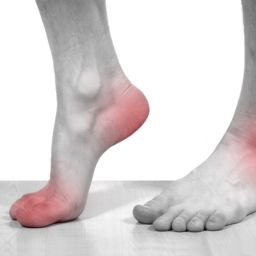
If the front of your foot hurts when you push off, stand on a tile floor or squeeze into a dress shoe, you have ball of foot pain. Doctors usually call it metatarsalgia, but that word only tells you where it hurts.
Underneath it sits an overloaded metatarsal head, a pinched nerve, a strained ligament under a toe, or a stress fracture. We see all four, in runners and pickleball players and just as often in people who spend the winter in sandals on tile floors.
The first thing we work out is which one you have, because the fix for a nerve isn’t the fix for a ligament. This page helps you narrow it down, and tells you when to stop waiting.
Where is the ball of the foot?
It’s the padded area under the front of your foot, between the arch and the toes. The American Orthopaedic Foot & Ankle Society (AOFAS) describes metatarsalgia as pain that centers on one or more of the five metatarsal bones in that area 3.
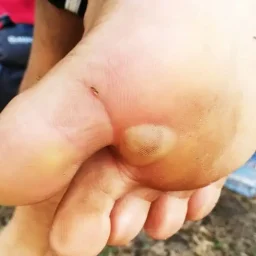
If your pain is on the upper side of the foot instead, this guide to the instep covers it. If what you have is a skin problem, not deep pain, see our blister guide.
Why does the ball of my foot hurt?
Mayo Clinic says a single factor can do it, but more often several stack up 1. The usual contributors:
- Hard training: Running and jumping load the front of the foot, especially in worn or poorly fitting shoes 1.
- Foot shape: A high arch, or a second toe longer than the big toe, shifts extra weight onto the second metatarsal head 1.
- Toe deformities: With a bunion, the big toe’s metatarsal can’t carry its share, so weight moves to the smaller metatarsals. A hammertoe can push a metatarsal toward the ground 3.
- Shoes: High heels and narrow toe boxes both put pressure on the forefoot 1.
- Body weight: Most of it goes through the forefoot as you move, so extra pounds add pressure 1.
- Other conditions: Stress fractures and Morton’s neuroma can cause the same pain 1.
Florida adds a few causes of its own. Sandals and flip-flops are everyday footwear here, and plenty of homes have tile floors that people cross barefoot all day. Mayo Clinic notes that standing, walking or running barefoot on a hard surface makes metatarsalgia pain worse 1. Hard-court sports like pickleball add repeated push-off on top of that.
Match your pain to a likely cause
You can’t reliably diagnose this at home, and the NHS says the same 6. But where the pain sits and how it feels narrow things down, and it’s what we ask about first. Use this table to describe your pain to a doctor, not to decide what you have.
| What You Feel | Where | What Often Goes With It | What It May Point To |
|---|---|---|---|
| Aching, sharp or burning pain that eases with rest | Across the ball of the foot, under one or more metatarsal heads | Worse when you stand, walk or run barefoot on a hard surface | Metatarsalgia from overload |
| Burning pain, numb toes or a pebble-in-the-shoe feeling | Between the toes, most often the second and third or the third and fourth | Tingling or a clicking feeling in the toes, worse in tight shoes | Morton’s neuroma |
| Aching pain with a knot or swelling that builds gradually | Under the base of a toe, most often the second | A toe that starts to drift out of line | Plantar plate tear |
| Pain that gets worse with push-off | Under the big toe joint | Tenderness directly beneath the first metatarsal head | Sesamoiditis or a sesamoid fracture |
| A deep ache that builds over weeks of activity | Often one metatarsal bone | May not settle with rest | Metatarsal stress fracture |
Four conditions that mimic simple overload
Could it be Morton’s neuroma?
Possibly, if the pain is burning or the toes feel numb. Morton’s neuroma is a thickening of the tissue around a nerve between the metatarsals. AOFAS says shoe changes, anti-inflammatory medication, orthotics or cortisone injections relieve it in more than 80% of people, according to several studies4. Our Morton’s neuroma treatment page covers diagnosis and options in full.
Could it be a plantar plate tear?
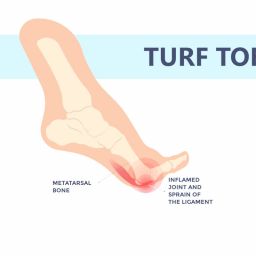
Think of it when the pain sits right under the base of a toe and builds gradually. The plantar plate is the ligament under the ball of the foot that keeps the toe joint stable. When it tears, the toe can lose that stability and start to drift 5, and AOFAS says successful treatment can take weeks or months 5. We cover the details in our plantar plate tear guide.
Could it be sesamoiditis or a sesamoid fracture?
Consider it if the pain is under the big toe joint. Two small sesamoid bones sit beneath the first metatarsal head, and they can be irritated or broken. Those are different problems with different timelines, so we’ve written them up separately. Start with our sesamoiditis treatment page, and read our sesamoid fracture guide if the pain began after an impact or has built over weeks. If the pain is in the joint itself rather than underneath it, our big toe guide is the better place to look.
What about a metatarsal stress fracture?
Mayo Clinic lists small breaks in the metatarsals as another cause, and says an X-ray is how a stress fracture gets ruled in or out 1, 2. That’s why we X-ray before assuming it’s simple overload.
What can I do at home this week?
For mild pain, Mayo Clinic says self-care may be all you need 2. In practice:
- Rest the foot and trade running or jumping for swimming or cycling for a while 2.
- Ice it for about 20 minutes at a time, with a thin towel between the ice and your skin 2.
- Try a metatarsal pad or an arch support. Both are sold over the counter 2.
- Take an over-the-counter pain reliever such as ibuprofen if it’s safe for you 2, and ask a pharmacist if you’re not sure 6.
Check your shoes first
Footwear is the cheapest fix and it has no side effects, so we start there. Choose shoes with a wide toe box and a low heel. AOFAS advises keeping heels no higher than 2¼ inches 3. If you live in sandals, swap in a cushioned pair for walking on hard floors, and put something soft on the floor of the rooms you cross barefoot.
What we do first. At CFAS we start conservatively, and footwear comes first because it costs nothing and has no side effects. We don’t order imaging for a straightforward case, but we do X-ray when a stress fracture is possible.
What happens at your first visit, and when not to wait
We examine your foot standing and sitting and watch you walk. Then we ask about your shoes and what you do in a typical week. Mayo Clinic lists the same starting questions.2
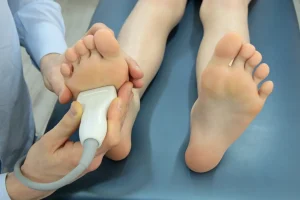
Most of the time we can take X-rays during the same visit. An X-ray shows bone, not ligament or nerve, so when the picture isn’t clear we can add ultrasound, an MRI or a weight-bearing CT scan on our PedCAT at select offices. You leave knowing what we think is going on and what to do about it that day.
Some things shouldn’t wait. Get seen the same day if you can’t walk on the foot, it has changed shape, you heard a snap or pop, or it’s hot and swollen and you feel feverish. The NHS lists the same warning signs 6. Tingling, loss of feeling or diabetes are reasons to come in sooner too 6. For everything else, Mayo Clinic says to act on foot pain that lasts more than a few days 1, and the NHS draws the line at two weeks of home care without improvement. 6
Will ball of foot pain go away on its own?
Sometimes. Many mild cases settle once the shoes and the activity change. Pain that keeps coming back usually means something is still overloading the foot, and an insole alone won’t tell you what. A plantar plate tear can leave a toe drifting out of line, and surgery for metatarsalgia itself is rare, reserved for when self-care fails and a deformity such as a hammertoe is involved. 2, 5
Get your forefoot pain checked
If the pain hasn’t eased with new shoes and a couple of weeks of rest, come see us. We treat forefoot pain at our Boca Raton and Tampa offices and at every other location across Florida. If you’re looking for a foot pain doctor or a podiatrist in Boca Raton or Tampa, you can request an appointment online.
Sources
- Mayo Clinic. Metatarsalgia: Symptoms & causes. Updated May 2, 2025. https://www.mayoclinic.org/diseases-conditions/metatarsalgia/symptoms-causes/syc-20354790
- Mayo Clinic. Metatarsalgia: Diagnosis & treatment. Updated May 2, 2025. https://www.mayoclinic.org/diseases-conditions/metatarsalgia/diagnosis-treatment/drc-20354795
- American Orthopaedic Foot & Ankle Society (FootCareMD). Metatarsalgia (Forefoot Pain). https://www.footcaremd.org/foot-and-ankle-conditions/toes/forefoot-pain-metatarsalgia
- American Orthopaedic Foot & Ankle Society (FootCareMD). Morton’s Neuroma. https://www.footcaremd.org/foot-and-ankle-conditions/toes/mortons-neuroma
- American Orthopaedic Foot & Ankle Society (FootCareMD). Plantar Plate Tear. https://www.footcaremd.org/foot-and-ankle-conditions/toes/plantar-plate-tear
- NHS. Pain in the ball of the foot. Page last reviewed November 5, 2025. https://www.nhs.uk/symptoms/foot-pain/pain-in-the-ball-of-the-foot/
Frequently Asked Questions About Pain in the Ball of the Foot
Why does the ball of my foot feel numb?
Numbness or tingling in the toes along with ball of foot pain points toward a nerve problem such as Morton’s neuroma, according to AOFAS. Tingling, loss of feeling or diabetes are also reasons to be seen sooner, and the NHS lists them as reasons not to wait on home care.
Will metatarsal pain ever go away?
Often it does. Mayo Clinic says self-care may be all that mild cases need, and the NHS suggests having the pain checked if home care hasn’t helped after two weeks. Pain that returns usually means something is still overloading the foot.
Will my feet get used to standing all day?
Don’t count on it. Mayo Clinic notes that standing, walking or running barefoot on a hard surface makes metatarsalgia pain worse, so a cushioned shoe or a soft mat does more than waiting it out. If the pain is there every day, have it looked at.
Why does it feel like I’m walking on a pebble or a marble?
That’s a classic description of Morton’s neuroma, according to AOFAS. Mayo Clinic also lists a pebble-in-the-shoe feeling among metatarsalgia symptoms, so the sensation alone doesn’t settle which one you have. Numbness or a clicking feeling in the toes makes the nerve more likely.
Do high heels cause pain in the ball of the foot?
They’re a common cause. Heels push weight onto the front of the foot, and Mayo Clinic lists high heels and narrow toe boxes among the usual triggers. AOFAS advises keeping heels no higher than 2¼ inches and choosing shoes with a wide toe box.
Can bunions or hammertoes cause pain in the ball of the foot?
Yes. AOFAS explains that a bunion can leave the big toe’s metatarsal unable to carry its share, so weight shifts to the smaller metatarsals, and a hammertoe can press a metatarsal bone toward the ground. When a deformity is driving the pain, better shoes may not be enough, and we look at orthotics and, in some cases, treatment of the bunion or hammertoe itself.
Is it safe to keep exercising with ball of foot pain?
Cut back on running and jumping first. Mayo Clinic suggests low-impact options such as swimming or cycling while the foot settles. If a stress fracture is possible, keep the load off the foot and get an X-ray before you go back to impact exercise.