
Sarah Hubbard
*About the Author: Sarah Hubbard
Sarah Hubbard is a medical writer for Certified Foot and Ankle Specialists with approximately 15 years of experience creating accurate, patient-focused healthcare content. She specializes in translating complex podiatric topics into clear, informative articles that help patients better understand foot and ankle conditions, treatment options, and preventive care.
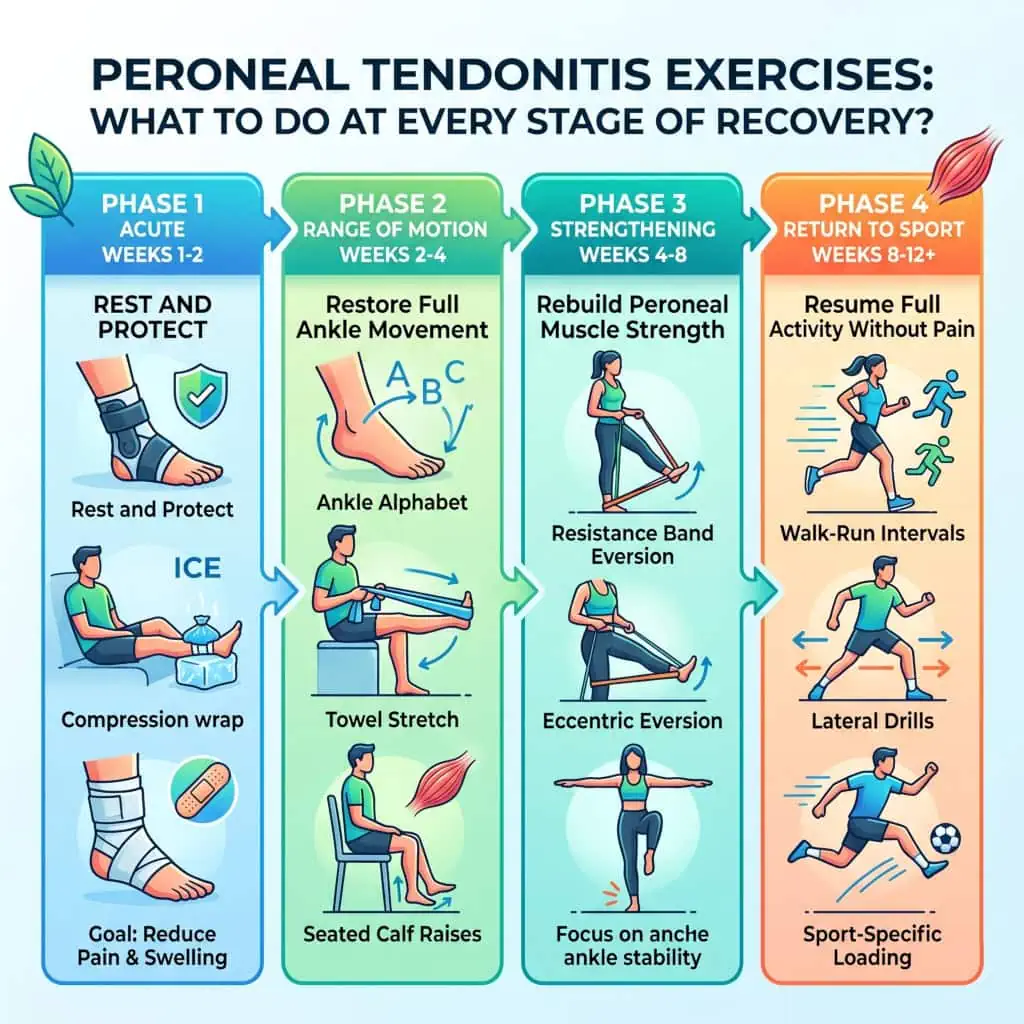
Peroneal tendonitis exercises fall into four stages: rest and protection in the acute phase, range-of-motion restoration, progressive strengthening, and sport-specific loading for return to activity. Starting the right exercises at the right time is what separates a complete recovery from a frustrating cycle of re-injury.
Key Takeaways
What exercises help peroneal tendonitis?
Resistance band eversion, eccentric ankle eversion, and single-leg balance training are the most effective. These directly target the peroneal muscles and rebuild the strength that protects the tendon from re-injury.
When can you start exercising with peroneal tendonitis?
Light range-of-motion exercises can begin in week 2, once resting pain drops below 3 out of 10. Strengthening starts around weeks 3 to 4, after swelling has resolved.
What exercises should you avoid with peroneal tendonitis? Avoid aggressive ankle stretching, inversion movements, and high-impact activity during the first two weeks. These worsen tendon irritation and slow recovery.
How long until peroneal tendonitis exercises feel pain-free?
Most patients complete pain-free strengthening within 6 to 8 weeks. Return-to-running protocols begin around weeks 8 to 12.
Can exercises prevent peroneal tendonitis from coming back?
Yes. A maintenance program of 2 to 3 strengthening sessions per week after recovery significantly cuts recurrence risk.
Peroneal Tendonitis Exercise Progression at a Glance
| Phase | Timeline | Goal | Key Interventions |
|---|---|---|---|
| Phase 1: Acute | Weeks 1–2 | Rest and protect | Ice, compression, brace |
| Phase 2: Range of Motion | Weeks 2–4 | Restore full ankle movement | Ankle alphabet, towel stretch, seated calf raises |
| Phase 3: Strengthening | Weeks 4–8 | Rebuild peroneal muscle strength | Resistance band eversion, eccentric eversion, single-leg balance |
| Phase 4: Return to Sport | Weeks 8–12+ | Resume full activity without pain | Walk-run intervals, lateral drills, sport-specific loading |
PHASE 1: ACUTE CARE IN Weeks 1 to 2
What Exercises Are Safe During the Acute Phase of Peroneal Tendonitis?
In the first 10 to 14 days, the goal isn’t exercise, it’s protecting the tendon while inflammation settles. The peroneal tendons run along the outer ankle and can’t handle load when they’re acutely inflamed.
What to do instead:
- Stop running, jumping, and lateral sport movements immediately. Gentle flat-surface walking is fine if pain stays below 3 out of 10.
- Ice and compression. Start by applying ice to the outer ankle for 15 to 20 minutes, 3 to 4 times daily. Use a compression wrap between sessions to limit swelling.
- Then keep your foot above heart level when resting, especially in the first 48 to 72 hours.
- Ankle brace. Finally lace-up or use a semi-rigid lateral ankle brace. This will reduce tendon load during your daily activities. Wear it during all weight-bearing hours or through the day when your most active.
What to skip in Phase 1: Don’t stretch or massage directly over the tendon. Don’t apply heat. Don’t test the ankle with a short run. All of these worsen irritation before the tendon has had a chance to settle.
⚠️ See a podiatrist before advancing if:
- Pain doesn’t decrease within 5 to 7 days of consistent rest and ice
- You can’t bear weight without significant pain
- Swelling increases rather than reduces over the first week
- You heard or felt a snap at the outer ankle at any point
PHASE 2: RANGE OF MOTION IN Weeks 2 to 4
What Exercises Restore Ankle Range of Motion After Peroneal Tendonitis?
Range of motion exercises begin around week 2, once acute inflammation is under control. The goal is restoring full, pain-free ankle movement without aggressively reloading the tendon.
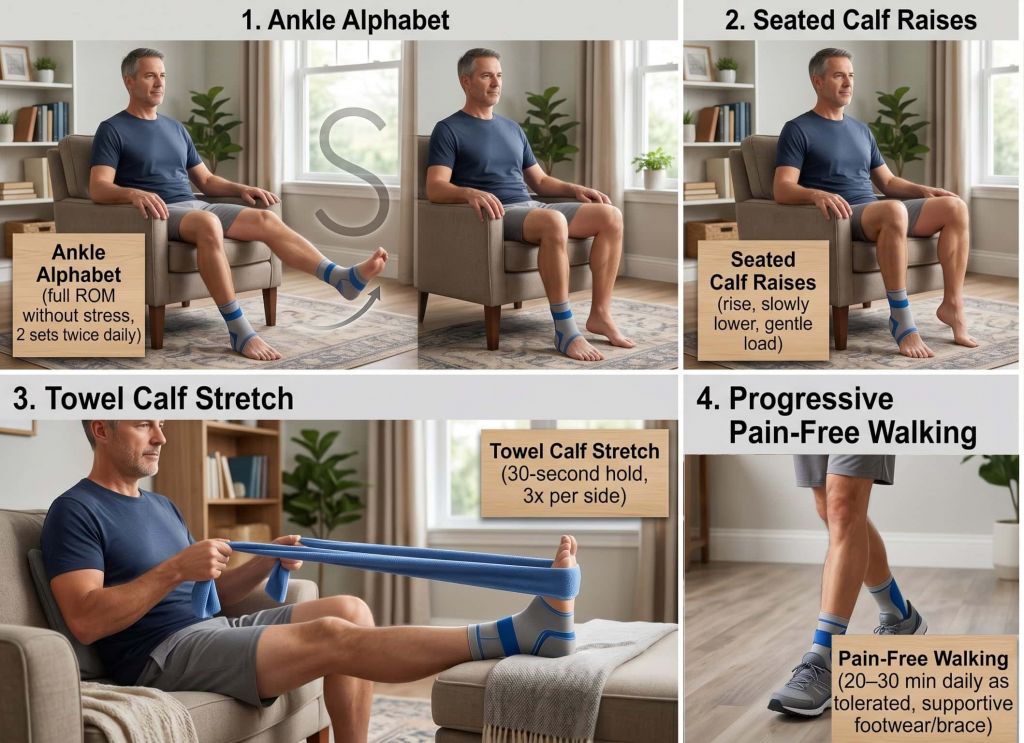
- First, try the Ankle Alphabet: Sit in a chair and trace the letters of the alphabet in the air with your foot. This takes the ankle through its full range of motion without weight-bearing stress. Two sets, twice daily.
- Next, move on to the Towel Calf Stretch: Loop a towel around the ball of your foot with your leg straight. Pull gently toward you and hold for 30 seconds. Repeat 3 times per side. Keep the pull gentle because you’re restoring range. Do not force the stretch, it is meant to be used to guide the process.
- From there, add Seated Calf Raises: Rise onto the ball of your foot while seated, then slowly lower. This introduces gentle load to the calf-peroneal chain without full body weight. Start with 2 sets of 15.
- Finally, progress to Pain-Free Walking: Progress from short, flat walks to 20 to 30 minutes daily as tolerated. Wear supportive footwear or your ankle brace throughout. Avoid inclines, trails, and cambered surfaces for now.
Also in Phase 2: This is the right time to address footwear and biomechanical issues that contributed to tendonitis in the first place. If you have high arches, flat feet, or a history of ankle sprains, our podiatrists can evaluate whether custom orthotics are appropriate.
Advance to Phase 3 when: You can walk 30 minutes pain-free and have full ankle range of motion.
PHASE 3: STRENGTHENING THE PERONEAL TENDON IN Weeks 4 to 8
What Strengthening Exercises Fix Peroneal Tendonitis?
Strengthening is the most critical phase for preventing recurrence. Eccentric loading, emphasizing the slow lowering phase of each movement, has the strongest clinical evidence for tendon rehabilitation, according to the Journal of Orthopedic and Sports Physical Therapy.
- Begin with Resistance Band Eversion: Anchor a resistance band at foot level and pull your foot outward against the band’s resistance, then slowly return to the start. Do 3 sets of 15 repetitions. Increase resistance weekly as strength improves.
- Once that feels comfortable, progress to Eccentric Ankle Eversion: Use your unaffected foot to move the ankle into inversion, then resist the return with your peroneal muscles only. The slow, controlled return phase is the therapeutic part. This is the single most effective exercise for rebuilding peroneal tendon strength.
- As you build strength, introduce Single-Leg Balance: Stand on the affected leg for 30 seconds with eyes open. Progress to eyes closed, then add a balance board. This rebuilds proprioception alongside muscle strength. Start only after calf raises are consistently pain-free.
- In addition, work through Bilateral to Single-Leg Calf Raises: Start with both feet and gradually shift to single-leg as strength allows. Target 3 sets of 15 at full height. Pain during the lowering phase is a sign to reduce load and progress more slowly.
- Finally, finish with Side-Stepping with Resistance Band: Place a band above the knees and side-step 10 to 15 steps in each direction. This targets the peroneal muscles in a functional, weight-bearing position and bridges the gap toward return to sport.
Advance to Phase 4 when: Single-leg calf raises are pain-free at full height, balance is symmetric between both legs, and lateral movements don’t cause outer ankle discomfort.
PHASE 4: RETURN TO SPORT ACTIVITIES IN Weeks 8 to 12+
How Do You Progress Exercises for Return to Running After Peroneal Tendonitis?
Return-to-running exercises begin around weeks 8 to 12, once full strength is confirmed. This phase is graduated — don’t jump back to pre-injury training volume.
- Start with Walk-Run Intervals in Week 1: Alternate 1 minute of easy jogging with 2 minutes of walking. Total 20 minutes. Pain must stay at or below 2 out of 10 throughout.
- From there, increase running intervals in Week 2: Progress to 2 minutes of running and 1 minute of walking if Week 1 was pain-free. Monitor for outer ankle soreness in the 24 hours after each session.
- Next, move to Continuous Easy Running in Week 3: Run 20 to 25 minutes of continuous easy-pace running on flat surfaces. Avoid cambered roads and trails at this stage.
- Finally, in Week 4 and beyond, introduce Sport-Specific Loading: Add lateral movements, cutting drills, and sport-specific patterns one at a time. Combine elements only once each is individually pain-free.
Maintenance program (ongoing after return to full activity):
- Resistance band eversion 2 to 3 times per week
- Replace athletic shoes every 300 to 400 miles
- Follow the 10% rule for any future training load increases
- Address any outer ankle soreness within 48 hours. Do not train through it
What Exercises Should You Avoid with Peroneal Tendonitis?
Certain movements consistently slow recovery and should be avoided until the tendon is fully healed.
During the acute phase (Weeks 1 to 2):
- Aggressive ankle stretching or foam rolling directly over the outer ankle
- Inversion movements : Rolling the ankle inward puts the peroneal tendons under stretch load when they’re inflamed
- High-impact activity including running, jumping, and lateral sport movements
- Barefoot walking on hard floors without supportive footwear
During the strengthening phase (Weeks 4 to 8):
- Training through pain above 3 out of 10
- Jumping to single-leg plyometrics without building through calf raises first
- Ignoring delayed soreness the day after exercise — this is a sign you’ve progressed too quickly
When Should You See a Podiatrist About Peroneal Tendon Exercises?
See a podiatrist before advancing your exercise program if any of the following apply:
- Pain doesn’t decrease within 5 to 7 days of consistent rest and ice
- You can’t bear weight without significant pain
- You heard or felt a snap at the outer ankle at any point
- Progress stalls during the strengthening phase despite consistent effort
- Swelling increases rather than resolves during the first week
A sudden snapping sensation, severe immediate pain, and significant outer ankle swelling can signal a peroneal tendon tear. These conditions look similar but require different management. MRI confirms the diagnosis. Don’t start a strengthening program if a tear is suspected.
The Bottom Line: Get the Exercises Right, and Recovery Follows
Peroneal tendonitis responds well to a structured, phased exercise program. The key is matching the right exercises to the right stage of recovery. Do not rush into strengthening before the tendon is ready, and not stopping the program the moment you feel better.
If your exercises aren’t producing progress or if you’re unsure which phase you’re in, our board-certified podiatrists at Certified Foot and Ankle Specialists can assess your tendon and build a recovery plan specific to your activity level. We treat peroneal tendon injuries across South Florida, including Boca Raton, Boynton Beach, West Palm Beach, Coral Springs, Delray Beach, and Pembroke Pines. Contact us to book an appointment with a foot specialist with a foot specialist near you.

Dr. Kyle Kinmon
*Medically Reviewed by: Dr. Kyle J. Kinmon, MS, DPM, FACFAS
This article was reviewed by a board-certified podiatrist with over 15 years of experience in diagnosing and treating foot and ankle conditions. Our practice specializes in comprehensive foot care, from common conditions like tendonitis to complex surgical interventions.
Frequently Asked Questions: Peroneal Tendonitis
Q: What are the best exercises for peroneal tendonitis?
A: Overall, the most effective peroneal tendonitis exercises are resistance band eversion, eccentric ankle eversion, and single-leg balance training. In particular eccentric eversion emphasizes the slow lowering phase against resistance. This has the strongest clinical evidence for tendon rehabilitation. These exercises should begin in Phase 3 of recovery, around weeks 4 to 8, after range of motion is fully restored.
Q: When can I start exercising with peroneal tendonitis?
A: In most cases light range-of-motion exercises such as ankle circles and towel stretching can begin around week 2, once resting pain drops below 3 out of 10. From there, strengthening exercises begin around weeks 3 to 4, after acute swelling has resolved. High-impact activity and lateral sport movements should be avoided until Phase 4, typically weeks 8 to 12.
Q: What exercises should you avoid with peroneal tendonitis?
A: During the acute phase, avoid aggressive ankle stretching, inversion movements, foam rolling over the outer ankle, and any high-impact or lateral activity. Similarly, during strengthening, avoid training through pain above 3 out of 10. Additionally, avoid jumping to plyometric exercises before building through calf raises, and ignoring soreness that appears the day after exercise.
Q: How long does it take for peroneal tendonitis exercises to work?
A: Genereally, most patients notice meaningful pain reduction within 2 to 4 weeks of starting appropriate conservative care. After that, strengthening exercises produce consistent gains over weeks 4 to 8. Subsequently, return-to-running protocols begin around weeks 8 to 12 for mild to moderate cases. Severe tendonitis or associated tendon tears can extend recovery to 3 to 6 months.
Q: What is eccentric ankle eversion and why is it used for peroneal tendonitis?
A: Eccentric ankle eversion involves using the unaffected foot to bring the ankle into inversion, then resisting the return movement with the peroneal muscles only. Specifically, the slow, controlled lowering phase is the therapeutic component. This is because eccentric loading promotes tendon remodeling and strength more effectively than concentric exercises alone, which is why it has the strongest evidence base for tendon rehabilitation.
Q: Can exercises prevent peroneal tendonitis from coming back?
A: YYes, and continuing a maintenance program of 2 to 3 peroneal strengthening sessions per week after returning to full activity significantly reduces recurrence risk. In particular, key maintenance exercises include resistance band eversion and single-leg balance. Furthermore, following the 10% rule for training load increases and replacing worn athletic shoes every 300 to 400 miles also lowers recurrence risk.