

Sarah Hubbard
*About the Author: Sarah Hubbard
Sarah Hubbard is a medical writer for Certified Foot and Ankle Specialists with approximately 15 years of experience creating accurate, patient-focused healthcare content. She specializes in translating complex podiatric topics into clear, informative articles that help patients better understand foot and ankle conditions, treatment options, and preventive care.
What is an ankle foot orthosis, and how does it correct drop foot?
An ankle foot orthosis corrects drop foot by preventing plantarflexion during the swing phase of your gait and maintaining a heel-strike landing at the start of the stance phase.
Without the brace, the weakened tibialis anterior and extensor digitorum longus muscles can’t lift the foot. The foot hangs down in plantarflexion as your leg swings forward. You either drag your toes on the floor, slap them down with each step (foot slap), or hike your knee unusually high to clear the ground. That compensatory movement is called a steppage gait, and it increases your fall risk significantly.
A well-fitted AFO eliminates the steppage gait by holding the ankle in a neutral position through the swing phase, restoring a more natural toe clearance. At heel-strike, the brace controls the rate of plantarflexion so the foot lowers to the floor in a controlled way rather than slapping down.
Will an AFO cure your foot drop, or is it a long-term device?
An AFO compensates for lost dorsiflexion. It does not heal the nerve or repair the underlying condition. Whether you’ll need it permanently depends almost entirely on why the nerve failed.
Compressive common peroneal nerve palsy, the kind caused by prolonged leg crossing, a tight cast, or direct pressure at the fibular head, often improves once the compression is removed. Recovery typically takes 6–12 weeks for mild cases, longer for severe injury. Many patients in this group can eventually wean out of the brace as strength returns.
Post-stroke hemiplegia, multiple sclerosis, Charcot-Marie-Tooth disease, and cerebral palsy are different situations. These are permanent or progressive neurological conditions. The AFO is a long-term management tool for most patients in these groups, not a bridge to recovery.
The honest answer at your first evaluation: we won’t know until we see how you respond over time.
What causes drop foot, and when is an AFO prescribed?
Drop foot results from any disruption to the nerve pathway that controls dorsiflexion, from the lumbar spine to the common peroneal nerve to the muscles that lift the foot.
The conditions that most commonly produce drop foot include:
- Peroneal nerve palsy or peroneal nerve injury: The common peroneal nerve wraps around the head of the fibula and is vulnerable to compression there. This is the single most common cause of isolated drop foot.
- L4–L5 lumbar radiculopathy (sciatica): Disc herniation compressing the L5 nerve root produces drop foot, often with lateral leg and dorsal foot numbness.
- Post-stroke hemiplegia: Drop foot is present in roughly 20% of stroke survivors with lower-limb weakness. Post-stroke gait dysfunction often requires a permanent AFO.
- Multiple sclerosis: MS damages the myelin sheath of motor neurons, producing variable or progressive dorsiflexion weakness.
- Charcot-Marie-Tooth disease (CMT): This hereditary peripheral neuropathy causes progressive lower leg weakness and high-arched feet, with drop foot appearing in adolescence or early adulthood.
- Cerebral palsy: Spastic or flaccid involvement of the ankle dorsiflexors affects gait from childhood, and AFO requirements change as the child’s skeleton matures.
- Diabetic peripheral neuropathy: Severe neuropathy can weaken dorsiflexion. More importantly, the insensate diabetic foot needs extra caution with any rigid brace. See the fitting section below.
How do specialists tell peroneal nerve palsy from a lumbar disc problem?
Both conditions can produce identical-looking drop foot, which is why evaluation matters before you order a brace. A clinician tests muscle strength using the MRC grading scale for dorsiflexion, eversion, and inversion, and checks for sensory differences. Peroneal nerve palsy typically spares ankle inversion, which is controlled by the tibial nerve at a different level. L5 radiculopathy usually weakens inversion as well and is often accompanied by low back pain or buttock pain radiating down the leg.
If the picture is unclear, the next steps are typically an electromyography (EMG) and nerve conduction study to localise the lesion, and a lumbar MRI to assess the disc and nerve root. Those decisions belong to your neurologist or spine specialist. At CFAS, we work alongside that workup so the orthotic prescription is ready once the diagnosis is confirmed.
When does new drop foot need emergency care?
Most drop foot develops over days to weeks and can be evaluated at a scheduled appointment. Call 911 or go to the emergency room immediately if your foot drop started suddenly and you also notice any of the following:
- Facial drooping, arm weakness, or difficulty speaking
- New loss of bladder or bowel control
- Numbness in the groin or inner thighs (saddle anaesthesia)
- Rapidly progressing weakness in both legs
- Severe, sudden back pain with leg weakness
These combinations suggest stroke, cauda equina syndrome, or another emergency that can’t wait. A foot and ankle specialist’s office is not the right first stop for these presentations.
Which type of AFO is right for your drop foot?
The right AFO is the one that matches how much ankle control you’ve lost, what your muscle tone is like, and how active you are. There’s no single best brace. Here’s how the main categories differ.
Posterior leaf spring and Swedish AFOs
A posterior leaf spring AFO sits behind the leg and lifts the foot during the swing phase. It allows a small amount of ankle flexibility, which makes walking feel more natural. A Swedish AFO uses slightly thicker polypropylene and adds lateral ankle stability on top of the toe-lift assist.
Best for: mild to moderate flaccid drop foot with a stable ankle. These designs fit inside most athletic shoes without sizing up more than half a size, and they are often the starting point for peroneal nerve palsy where recovery is expected.
Carbon fiber AFOs: who actually benefits?
A carbon fiber AFO stores energy as your heel hits the ground and releases it as you push off, producing a more propulsive stride. It is lighter and thinner than polypropylene, which improves shoe fit and reduces leg fatigue over the course of a day.
A 2024 randomised controlled trial published in the Journal of Rehabilitation Medicine found that carbon fiber and traditional plastic AFOs produced comparable objective gait outcomes in stroke patients, but 67% of participants preferred to keep the carbon fiber device, citing perceived improvements in step length and fatigue reduction. Carbon fiber is not automatically better for everyone, but for active walkers who spend most of the day on their feet, the difference in wearability is real.
Best for: moderate to severe drop foot in patients with a stable ankle who want to stay active. Not ideal if you have significant ankle-foot deformity, spasticity, or fluctuating swelling, because the energy-return mechanics depend on consistent alignment.
Solid (rigid) and articulated (hinged) AFOs
A solid AFO locks the ankle in place with no motion allowed. It provides the highest level of control and is almost always custom-molded to the patient’s leg, because the total-contact surface that makes it effective also makes a bad fit dangerous. It’s prescribed for severe instability, significant spasticity, or deformity.
An articulated or hinged AFO includes a mechanical joint at the ankle set to allow a specific range of motion. This is useful in post-surgical recovery where some controlled movement promotes healing, or in neurological conditions where ankle motion is partially preserved. Like the solid AFO, it is custom-fitted.
What is a PRAFO boot, and is it different from a walking AFO?
A PRAFO (positioning relief ankle foot orthosis) is built to hold the ankle neutral and lift the heel off the mattress for patients who are not primarily walking. Its main job is preventing heel pressure injuries and equinus contracture in bed-bound or non-ambulatory patients. Some PRAFO models allow limited ambulation, but this is not a walking AFO and should not be substituted for one.
If you’ve searched for a PRAFO boot and found this page, you may actually need a walking AFO, a positioning device, or both depending on your situation. A clinical evaluation will clarify which is appropriate.
When should you choose a custom-fitted AFO over an off-the-shelf brace?
An off-the-shelf brace fits a statistical average. A custom-fitted AFO is fabricated to a plaster or digital cast of your specific leg and foot. Custom fitting is indicated when:
- You have ankle-foot deformity, high arches, or flat feet that a standard shell can’t accommodate
- You have significant spasticity or involuntary muscle tone that shifts the foot out of a generic shell
- Your ankle or foot swells in a way that changes dimensions across the day
- You have reduced or absent sensation in the foot (see the neuropathy section below)
- An off-the-shelf trial produced pressure sores or failed to control your gait
At Certified Foot and Ankle Specialists, we evaluate the full clinical picture and custom-fit the device in the clinic. The brace is fabricated by a certified orthotics laboratory to the specifications from that evaluation.
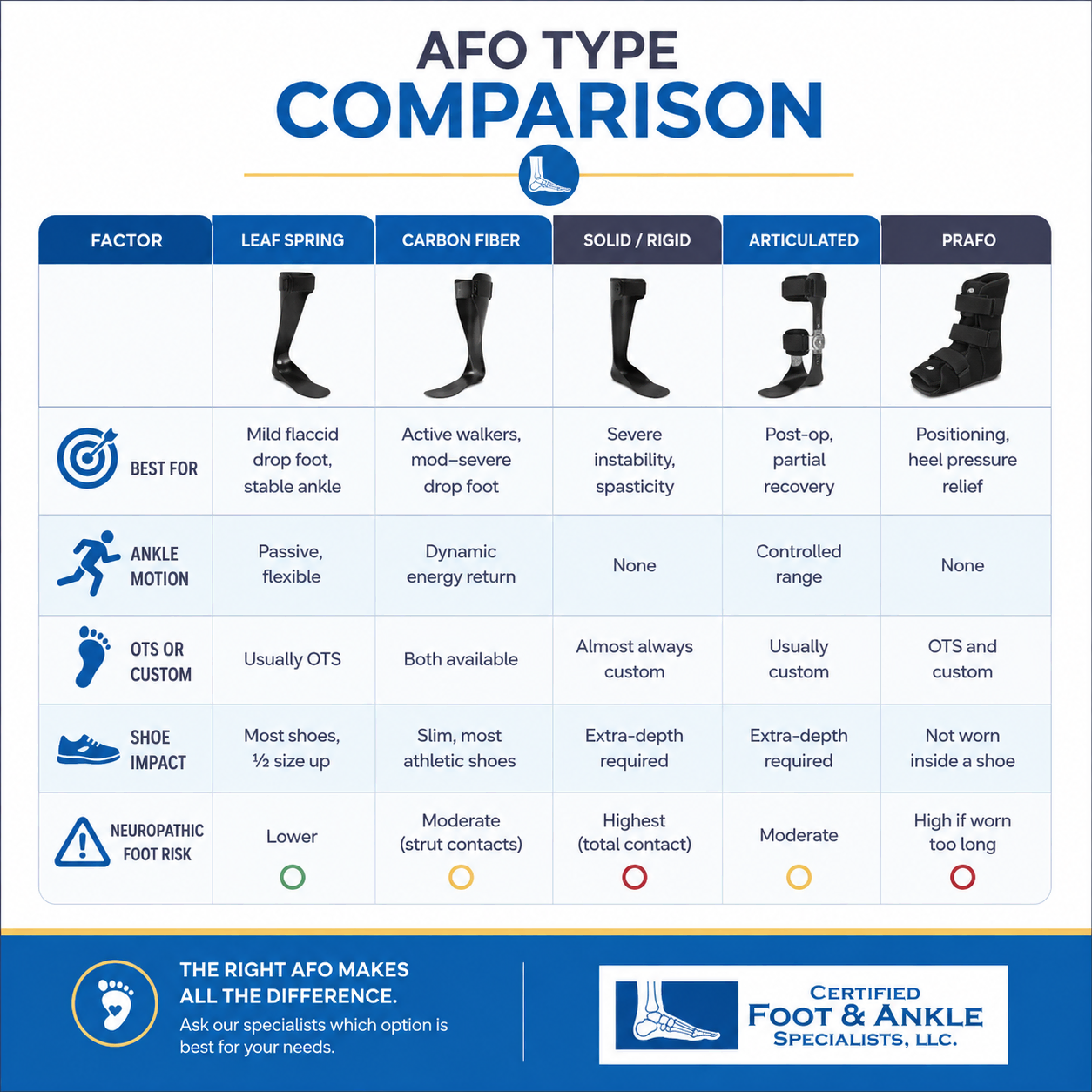
AFO TYPE COMPARISON
| Factor | Leaf spring | Carbon fiber | Solid / rigid | Articulated | PRAFO |
|---|---|---|---|---|---|
| Best for | Mild flaccid drop foot, stable ankle | Active walkers, mod–severe drop foot | Severe instability, spasticity | Post-op, partial recovery | Positioning, heel pressure relief |
| Ankle motion | Passive, flexible | Dynamic energy return | None | Controlled range | None |
| OTS or custom | Usually OTS | Both available | Almost always custom | Usually custom | OTS and custom |
| Shoe impact | Most shoes, ½ size up | Slim, most athletic shoes | Extra-depth required | Extra-depth required | Not worn inside a shoe |
| Neuropathic foot risk | Lower | Moderate (strut contacts) | Highest (total contact) | Moderate | High if worn too long |
How do you wear an AFO without blisters, pressure sores, or shoe problems?
Fitting a brace is only half the battle. Most AFO problems, including blisters, pressure ulcers, and skin breakdown, happen in the first two weeks, before the patient and the brace have adapted to each other. Here’s what to know before you leave the office.
How do you fit normal shoes over an AFO drop foot brace?
Buy the shoe with the brace on. That sounds obvious, but patients who order shoes online or pull a pair from their closet consistently underestimate how much the brace changes the volume inside the shoe.
What to look for in an AFO-compatible shoe:
- Go up at least half a shoe size, sometimes a full size depending on the AFO’s bulk
- Extra-depth or high-volume shoe design with a removable insole
- Wide or extra-wide toe box so the AFO shell doesn’t press laterally
- Firm heel counter so the back of the shoe doesn’t collapse
- Adjustable closure, laces or velcro, not slip-ons
Athletic training shoes and walking shoes work for most people. Narrow dress shoes and loafers rarely work at all, and forcing the foot in damages both the brace and the skin.
What socks should you wear under an AFO to prevent blisters?
The Florida heat makes this more important than in most places. Sweat trapped between the brace and the skin accelerates skin breakdown and odour.
Use a thin, seamless moisture-wicking sock, synthetic or merino wool, tall enough to extend above the brace’s calf cuff. Avoid thick cotton socks, they bunch inside the brace and act as sandpaper against the calf. Seams at the toe become pressure points under a rigid shell.
Some patients use a thin liner sock on the foot and a thicker sock on the calf above the AFO. That combination works well if the shoe has enough room.
How many hours a day should you wear a new AFO?
Start with a break-in schedule, not full-day wear on day one. A typical starting protocol:
- Week 1: 2–3 hours in the morning, remove for 30 minutes, 2–3 hours in the afternoon
- Week 2: 4–5 hours in the morning with a 30-minute rest midday, 3–4 hours in the afternoon
- Week 3 onward: increase by 1–2 hours per day toward full-day wear as tolerated
After every session, especially in the first two weeks, remove the brace and check the skin. Redness that blanches (turns white when pressed) and fades within 20 minutes is normal adaptation. Redness that does not blanch, persists beyond 20 minutes, or appears over a bony prominence is a pressure warning. Stop wearing the brace and call us.
This schedule is a general guideline. Your specific protocol should come from whoever fits the device. If anything about the break-in feels wrong, call before waiting for your next scheduled appointment.
What if you have diabetes or neuropathy? The critical difference
This is the section that matters most for a significant portion of our Florida patients, and it is the section most often skipped by online guides.
If you have diabetic peripheral neuropathy or any other condition that reduces or eliminates sensation in your foot, you can develop a serious skin injury from a rigid brace and never feel it happening. A normal person feels a hot spot and removes the brace. An insensate foot does not send that signal.
The precautions are not optional:
- Remove the brace and inspect the entire foot every time you take it off, including the heel, the ankle prominences, and the dorsum
- Use a hand mirror or your phone camera for the heel and sole
- Any non-blanching redness, blister, or skin break means the brace stops until the skin is evaluated
- Never wear the AFO to bed, and never fall asleep in the chair with it on, unless explicitly instructed by a clinician
Our South Florida team includes Dr. Ashley Bowles, DPM, FACFAS, CWSP, a board-certified podiatrist and Certified Wound Specialist with specific training in neuropathic foot care. If you have diabetes and are considering an AFO, that combination of wound-care expertise and orthotic evaluation is exactly what you need in one place.
Does insurance or Medicare cover a custom AFO for drop foot?
Medicare Part B and most private insurance plans cover an AFO when it is documented as medically necessary. General guidance only is provided here because coverage rules change, local coverage determinations vary by region, and your specific plan may have additional requirements.
What Medicare generally requires for AFO coverage:
- A face-to-face visit with a treating physician or qualified non-physician practitioner documenting the diagnosis and the functional limitation the AFO addresses
- A written order or prescription that specifies the type of device
- Documentation that the device is medically necessary for the patient’s specific condition
- The device must be supplied by a Medicare-enrolled supplier
Private insurance requirements vary widely. Some plans require pre-authorisation. Some require that the device be supplied by a specific network provider. The distinction between a prefabricated and a custom-fabricated device also affects coverage levels.
The most reliable path: bring your insurance card to your evaluation. We can tell you what the documentation process looks like from our end. Confirm your plan’s specific coverage, deductibles, and co-insurance with your insurer before the fitting appointment.
A note on replacement
Medicare and most insurers have a useful-lifetime or replacement-interval rule for orthotics. A custom AFO typically qualifies for replacement if it is worn out, if the patient’s condition changes significantly, or after a defined period (often several years). The face-to-face and documentation requirements apply to replacements as well. Confirm the current rule for your plan.
When should you see a foot and ankle specialist about ankle foot orthosis drop foot?
If you already have a neurological diagnosis and your neurologist or primary care doctor has told you that an AFO is appropriate, the next step is an in-person evaluation with a foot and ankle specialist who can prescribe the right device and fit it correctly.
At the evaluation, expect:
- Assessment of ankle and foot alignment, muscle strength, and skin integrity
- Discussion of your activity level, footwear, and daily walking demands
- Recommendation of the AFO type best suited to your pattern of weakness
- Measurements or casting for a custom-fit device if indicated
- A fitting appointment once the brace is fabricated, with gait assessment and adjustments
The brace is one part of managing drop foot. If physical therapy has been recommended for strength, balance, and gait retraining, the two work together rather than replacing each other.
According to the American College of Foot and Ankle Surgeons (ACFAS), early orthotic intervention in neurological drop foot reduces fall risk and improves ambulatory function. Waiting to see if the condition resolves on its own, without a brace, increases fall exposure during that period.
What about surgery for drop foot?
In some patients with permanent flaccid drop foot and sufficient lower leg strength in the posterior compartment, a tendon transfer procedure can restore active dorsiflexion without a brace. Posterior tibial tendon transfer is one option discussed in that workup. Peroneal nerve decompression is considered for compressive lesions where the nerve remains viable.
These are decisions made by a foot and ankle surgeon in collaboration with your neurologist based on the cause, the duration of weakness, and the results of nerve testing. If surgical options are appropriate for your situation, your CFAS evaluation will include a conversation about that pathway.
Schedule your AFO evaluation at Certified Foot and Ankle Specialists
Southeast Florida (Boca Raton, West Palm Beach, Boynton Beach, Coral Springs): Dr. Ashley Bowles, DPM, FACFAS, CWSP evaluates, prescribes, and custom-fits AFO braces for drop foot. Her wound-care credential (CWSP) makes her evaluation particularly important for patients with diabetes or neuropathy.
Southwest Florida (Fort Myers, Cape Coral): Dr. Victor L. Herrera, DPM, ABMSP evaluates and fits drop foot braces across our West Coast Florida locations.
To schedule: contact your nearest Certified Foot and Ankle Specialists location. If you have a recent neurological evaluation or imaging, bring it to the appointment. Our team coordinates with your treating neurologist or spine specialist so your orthotic prescription fits your full clinical picture.
Frequently Asked Questions About Ankle Foot Orthosis for Drop Foot
Q: What is an ankle foot orthosis for drop foot?
A: An ankle foot orthosis (AFO) is a custom-fitted brace worn from the lower leg to the foot that holds the ankle at roughly 90 degrees of neutral. It compensates for lost dorsiflexion so the toes clear the ground during the swing phase of walking, eliminating toe drag and the compensatory steppage gait that raises fall risk.
Q: Will an AFO brace fix my foot drop permanently?
A: An AFO compensates for lost dorsiflexion but does not heal the underlying nerve or neurological condition. Compressive peroneal nerve palsy often recovers over 6 to 12 weeks once the pressure is removed, allowing patients to wean out of the brace. Drop foot from stroke, multiple sclerosis, or Charcot-Marie-Tooth disease typically requires a long-term brace because the underlying condition is permanent or progressive.
Q: What is the best brace for foot drop?
A: There is no single best brace for all cases. A posterior leaf spring AFO suits mild flaccid drop foot with a stable ankle. A carbon fiber AFO works well for active walkers with moderate to severe drop foot who need energy return and a slim profile. Solid and articulated AFOs are for severe instability or spasticity and are almost always custom-molded. A clinical evaluation determines which type matches your specific pattern of weakness and ankle alignment.
Q: Can you wear normal shoes with an AFO brace?
A: Yes, but shoe selection matters. Most people need to go up at least half a shoe size and choose a shoe with a removable insole, wide toe box, firm heel counter, and adjustable closure such as laces or velcro. Buy the shoe with the brace on. Slip-ons and narrow dress shoes rarely fit over an AFO without damaging the skin or the brace.
Q: Does Medicare cover an AFO brace for foot drop?
A: Medicare Part B generally covers an ankle foot orthosis for foot drop when it is documented as medically necessary. Coverage requires a face-to-face visit with a treating clinician, a written order, and documentation of the diagnosis and functional limitation. Coverage terms and deductibles vary by plan; confirm your specific coverage before the fitting appointment.
Q: What is the difference between a PRAFO boot and a walking AFO?
A: A PRAFO (positioning relief ankle foot orthosis) is designed to hold the ankle neutral and lift the heel off the mattress for bed-bound or non-ambulatory patients. Its primary purpose is preventing heel pressure injuries and equinus contracture, not supporting gait. A walking AFO is designed to improve toe clearance and gait stability. The two devices serve different functions and should not be substituted for each other.
Q: What is the difference between an AFO and an SMO?
A: An AFO (ankle foot orthosis) extends from below the knee to the toes and controls ankle and foot alignment including dorsiflexion. An SMO (supra-malleolar orthosis) ends just above the ankle bones and controls foot alignment without restricting ankle motion. SMOs are typically used for children or adults with mild flatfoot or rotational problems where ankle motion is preserved. Drop foot requires an AFO because the dorsiflexion deficit is at the ankle level.
Q: How many hours a day should you wear a new AFO brace?
A: Start with 2 to 3 hours in the morning and 2 to 3 hours in the afternoon during the first week, increasing by 1 to 2 hours per day across weeks 2 and 3 toward full-day wear. After every session in the first two weeks, remove the brace and check the skin. Redness that fades within 20 minutes is normal. Redness that persists beyond 20 minutes or appears over a bony prominence is a pressure warning and requires a call to the fitting clinician.